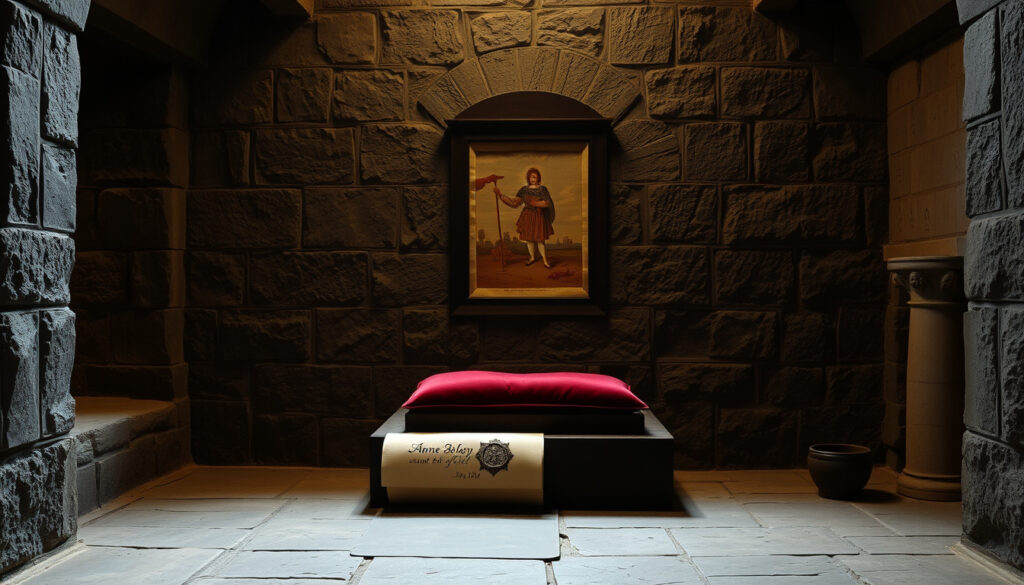
Anne Boleyn: The Evidence Behind Her Execution and Legacy
Few figures in Tudor history divide opinion as strongly as Anne Boleyn. She was executed on 19 May 1536 at the Tower of London after a trial that many historians consider a political show.
Born: c. 1501 or 1507 ·
Died: May 19, 1536 ·
Spouse: Henry VIII ·
Children: 1 (Elizabeth I) ·
Cause of death: Beheading for treason
Quick snapshot
- Executed by beheading on Tower Green, 19 May 1536 (Historic Royal Palaces)
- Convicted of adultery, incest, and conspiracy against the king (HISTORY.com)
- Mother of Elizabeth I (Encyclopaedia Britannica)
- Exact birth year – 1501 or 1507 remain possible (Encyclopaedia Britannica)
- Whether she actually committed adultery – modern historians widely consider the charges false (Encyclopaedia Britannica)
- Physical deformity claims (sixth finger, neck cyst) – described by opponents and later writers, likely myth (Historic Royal Palaces)
- Secret marriage to Henry VIII: January 1533 (Historic Royal Palaces)
- Arrest followed by trial and conviction: May 2–15, 1536 (Origins: Current Events in Historical Perspective – academic history journal)
- Execution on Tower Green: 19 May 1536 (The National Archives Blog – UK government archive)
- Anne’s reputation continues to be debated, inspiring books, films, and reinterpretations (History Extra)
- Major modern trend: Anne portrayed as an innocent woman framed by Henry VIII or Thomas Cromwell (History Extra)
- Her annulled marriage helped bring about the English Reformation (BBC History)
Six key facts about Anne Boleyn, one pattern: her timeline moves fast from romance to ruin in less than four years.
| Label | Value |
|---|---|
| Full Name | Anne Boleyn |
| Born | c. 1501 or 1507 |
| Died | May 19, 1536, Tower of London |
| Spouse | Henry VIII |
| Children | Elizabeth I (born 1533) |
| Cause of Death | Beheading |
Why did Henry VIII execute Anne Boleyn?
The official charges were treason, adultery, incest, and witchcraft. Anne Boleyn was arrested on 2 May 1536 and taken to the Tower of London. At a trial before a court of peers, she was unanimously convicted. On 15 May the verdict was read; on 19 May she was beheaded on Tower Green.
Modern historians widely view the charges as false or unproven. The pattern fits a political show trial orchestrated by Thomas Cromwell and Henry VIII to remove a queen who could not produce a male heir.
Did Henry VIII ever regret killing Anne Boleyn?
After the execution, Henry married Jane Seymour within days. Yet some historians argue he later regretted the act because it left political instability and tarnished his legacy. The National Archives notes that instructions for an earlier beheading on 18 May were not followed; the execution was delayed to 19 May, suggesting last-minute hesitation or logistical confusion. Whatever Henry’s private feelings, his public actions after 1536 show no sign of mourning.
The implication: Henry’s desire for a male heir and his interest in Jane Seymour drove the case forward. Regret, if it existed, changed nothing for Anne.
How many times did Anne Boleyn give birth?
Anne Boleyn had at least three confirmed pregnancies. The live birth was Elizabeth on 7 September 1533. A stillbirth occurred in 1534, and a miscarriage of a male fetus in January 1536. Some historians suspect another pregnancy loss in 1535, but evidence is inconclusive.
Her inability to produce a surviving son was a central factor in her downfall. Henry VIII needed a male heir to secure the Tudor dynasty, and Anne’s miscarriages undermined her position.
Bottom line: Anne’s reproductive history shows exactly one living child. For a queen whose primary duty was to bear a prince, that failure sealed her fate.
What did Anne Boleyn say before she died?
“I pray God save the king and send him long to reign over you, a more gentle nor a more merciful prince was there never, and to me he was ever a good, a gentle and sovereign lord.”
— Anne Boleyn, on the scaffold, 19 May 1536 (as recorded by contemporary accounts, cited by Historic Royal Palaces)
Her final words were carefully crafted to avoid implicating Elizabeth. Some historians believe Anne’s speech was designed to protect her daughter by declaring loyalty to the king. She also said, “I am come hither to die,” accepting her fate with composure.
“I have no cause to be sorry for her, but I am sorry for the king.”
— Sir Thomas More, letter to his daughter, referring to Anne Boleyn’s influence (cited by History Extra)
Anne praised her executioner as “a good, a gentle and sovereign lord” — the same man who signed her death warrant. Either she chose strategic denial or she valued the Elizabethan succession above her own life.
The pattern: the same assertiveness that won the king’s heart eventually made her a target.
How old was Anne Boleyn when she was with Henry?
Anne Boleyn was about 25-26 when she married Henry VIII in 1533. Her exact birth year is uncertain — either 1501 or 1507 — but both estimates place her in her mid-20s when she caught the king’s attention around 1526. She was serving as a lady-in-waiting to Catherine of Aragon when Henry began pursuing her.
How did Anne Boleyn meet Henry VIII?
Anne returned from French court education in 1522 and entered the household of Queen Catherine. Henry likely noticed her during court festivities. Unlike her sister Mary, who became the king’s mistress, Anne refused to become Henry’s lover unless he married her — a gamble that lasted nearly seven years of courtship.
How old was Mary Boleyn when she slept with Henry?
Mary Boleyn’s affair with Henry VIII is estimated to have occurred around 1521-1524, when she was about 20-23. She was married off after the relationship ended and was never accused of scheming for power. The contrast with Anne — who was executed — shows how differently the two sisters were treated by the crown.
Who was the rudest wife of Henry VIII?
The title “rudest wife” is subjective, but historical accounts describe Anne as spirited and outspoken, often engaging in sharp verbal exchanges with Henry. Katherine of Aragon was praised for dignity; Catherine Howard was flighty; Catherine Parr was diplomatic. Anne’s boldness, while attractive to Henry at first, later became a liability.
The pattern: the same assertiveness that won the king’s heart eventually made her a target.
What was Anne Boleyn’s role in the English Reformation?
Anne Boleyn was a known supporter of reformist religious ideas and owned books banned in England. She protected Protestant reformers and may have influenced Henry’s break with Rome. Her annulled marriage to Henry VIII helped accelerate England’s separation from the Catholic Church.
What disease did Anne Boleyn have?
In 1528, Anne Boleyn contracted the sweating sickness, a highly contagious and often fatal disease. She survived, but the illness left lasting effects — possibly contributing to later miscarriages. Some historians have speculated she may have had a thyroid condition or a genetic disorder that affected pregnancies, but no definitive diagnosis exists.
The trade-off: the sweating sickness may have caused chronic health problems that directly contributed to her inability to bear a healthy male heir.
Timeline of Anne Boleyn’s life
- c. 1501 or 1507 – Anne Boleyn born (Origins)
- 1522 – Returns to England from France, joins court of Catherine of Aragon (The National Archives Blog)
- 1526 – Henry VIII begins pursuing Anne (History Extra)
- January 1533 – Secret marriage to Henry VIII (BBC History)
- June 1533 – Coronation as queen consort (Origins)
- September 7, 1533 – Birth of Elizabeth I (The National Archives Blog)
- 1534 – Stillbirth of a child (English Heritage)
- January 1536 – Miscarriage of a male fetus (English Heritage)
- May 2, 1536 – Arrested and taken to the Tower of London (English Heritage)
- May 15, 1536 – Trial and conviction (British Library)
- May 19, 1536 – Execution by beheading (British Library)
The timeline shows a rapid rise and fall: from secret marriage to execution in just over three years.
What we know and what remains unclear
Confirmed facts
- Anne Boleyn was executed on May 19, 1536 (History Today)
- She was the mother of Elizabeth I (HISTORY.com)
- She married Henry VIII in 1533 (HISTORY.com)
- She was convicted of adultery, incest, and treason (British Library)
What’s unclear
- Exact birth year (1501 or 1507) (Royal Family)
- Whether she actually committed adultery – widely considered false by modern historians (Royal Family)
- Whether she had a sixth finger or other deformities – likely myth originating from her opponents (Royal Family)
- The exact nature of her illness (sweating sickness vs. a chronic condition) (History Today)
What contemporaries said about Anne Boleyn
“I pray God save the king and send him long to reign over you, a more gentle nor a more merciful prince was there never, and to me he was ever a good, a gentle and sovereign lord.”
— Anne Boleyn, on the scaffold, 19 May 1536 (as recorded by contemporary accounts, cited by Historic Royal Palaces)
“I have no cause to be sorry for her, but I am sorry for the king.”
— Sir Thomas More, letter to his daughter, referring to Anne Boleyn’s influence (cited by History Extra)
Anne Boleyn’s story is not just a tragedy of a queen who lost her head. It is a case study in how political expediency, gender expectations, and the need for a male heir can reshape a life into myth. Anne Boleyn’s fate demonstrates how political expediency and gender expectations can reshape a life into myth, reminding us that the evidence often holds fewer monsters than the legends suggest.
For readers interested in how other historical women have been mythologized, see Mary Magdalene: The Real Story of the Apostle to the Apostles and the modern royal perspective in Sarah Ferguson: Net Worth, Cancer, and Life with Prince Andrew.
en.wikipedia.org, biography.com, thefallofanneboleyn.com, tudorplaces.com, englandcast.com
Frequently asked questions
What was Anne Boleyn’s early life like?
Anne was likely born at Blickling Hall in Norfolk, educated in the Netherlands and France, and returned to England in 1522 to serve in Queen Catherine’s court (Encyclopaedia Britannica).
Did Anne Boleyn have a sixth finger?
Historic Royal Palaces frames this claim as a hostile description by opponents and later writers, not a verified fact.
Who was Anne Boleyn’s mother?
Her mother was Elizabeth Howard, a member of the powerful Howard family. Her father was Sir Thomas Boleyn (Encyclopaedia Britannica).
What was Anne Boleyn’s relationship with her sister Mary?
Mary Boleyn was Henry VIII’s mistress before Anne. After Anne became queen, Mary was given some favors but largely kept at a distance. Anne’s downfall affected Mary’s status (History Extra).
How is Anne Boleyn portrayed in popular culture?
She has inspired numerous books, TV series (The Tudors, Wolf Hall), and films. Interpretations range from manipulative schemer to innocent victim, reflecting ongoing debates among historians (Historic Royal Palaces).
What happened to Anne Boleyn’s daughter Elizabeth?
Elizabeth I became one of England’s greatest monarchs. Her birth was a disappointment to Henry, but she later ruled for 45 years and established the Elizabethan era (Encyclopaedia Britannica).
Where is Anne Boleyn buried?
Anne’s body was interred in the chapel of St Peter ad Vincula within the Tower of London precinct (HISTORY.com).
More related posts
 St. Denis Medical Episodes – Season 1 Guide and Recaps
 Booster Seat Age & Rules Ireland – Complete Guide 2025
 Can Dogs Eat Blueberries – Safety, Benefits and Feeding Guide
 Vic Michaelis: Age, Pronouns, Partner, and Biography
 Steven Bartlett: Net Worth, ADHD Diagnosis & Biography
 Sri Lanka vs New Zealand Match Scorecard – Full Stats, Results & Highlights
 TD Bank Open Today – Complete Hours Guide for 2026
 Brooke Henderson: Career, Personal Life & Comeback
