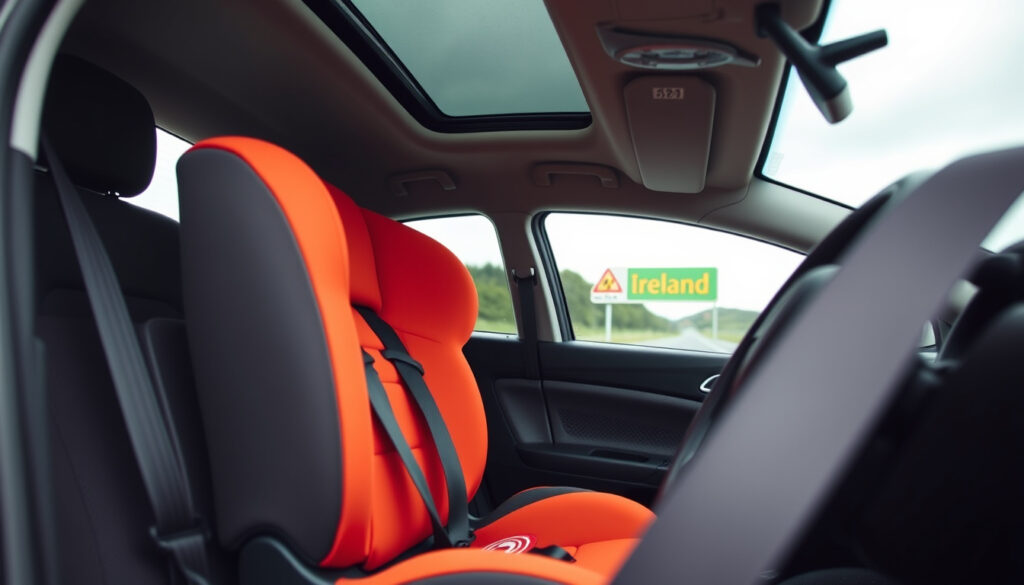
Booster Seat Age & Rules Ireland – Complete Guide 2025
If you’ve just moved your child out of a forward-facing car seat, you’re probably wondering what comes next. The booster seat stage is less straightforward than it looks — especially when Irish law, weight limits, and safety advice all pull in different directions.
Minimum age: 4 years (by law) ·
Weight range: 15-36 kg (33-79 lbs) ·
Height requirement: Typically 100-150 cm ·
Types: High-back and backless ·
Use until: 150 cm tall or 12 years
Quick snapshot
- Irish law requires booster seat use from age 4 to 150 cm or 12 years (Aviva Ireland (insurer guidance))
- Children under 150 cm or 36 kg must use a child restraint (HSE Ireland (public health authority))
- Backless boosters only allowed over 22 kg (Halfords Ireland (retailer compliance guide))
- Exact enforcement practices vary by region in Ireland (Tusla (child welfare agency PDF))
- Long-term safety data comparing backless vs high-back is limited (Tusla (child welfare agency PDF))
- Exact age at which a child can safely transition to a backless booster depends on individual development (Tusla (child welfare agency PDF))
- Long-term durability of booster seats over time is not standardized (Tusla (child welfare agency PDF))
- Effectiveness of head support in preventing whiplash in older children is not fully quantified (Tusla (child welfare agency PDF))
- Upcoming law: children must remain rear-facing until 15 months (Road Safety Authority Ireland (official video))
- Child can move to seat belt alone at 150 cm or 36 kg (AIG Ireland (insurer safety blog))
Six key numbers, one rule: Irish law puts height and weight above age.
| Requirement | Details |
|---|---|
| Legal minimum age for booster | 4 years (Aviva Ireland) |
| Minimum weight for high-back booster | 15 kg (Halfords Ireland) |
| Minimum weight for backless booster | 22 kg (Halfords Ireland) |
| Children must use restraint until | 150 cm or 36 kg (HSE Ireland) |
| Typical booster seat age range | 6–11/12 years (Tusla) |
| Front seat legal for children? | Yes, with correct restraint (HSE Ireland) |
What age can I have my child in a booster seat?
Legal age requirements in Ireland
- Irish law: children aged 3 and over under 150 cm or 36 kg must use a child restraint (HSE Ireland).
- Booster seats are the recommended stage after a forward-facing harness, typically from age 4 (Aviva Ireland).
The law in the Republic of Ireland does not set a specific minimum age for a booster seat. Instead, it says any child who is under 150 cm tall or weighs less than 36 kg must be in a child restraint system appropriate for their size (HSE Ireland). In practice, most children graduate to a booster around their fourth birthday, once they outgrow the harness limits of their forward-facing seat.
Age versus weight guidelines
- Weight 15 kg: minimum for high-back booster (Halfords Ireland).
- Weight 22 kg: minimum for backless booster (Halfords Ireland).
- Height 150 cm or weight 36 kg: can use seat belt without booster (AIG Ireland).
Weight is the primary factor. A 4-year-old who weighs 18 kg can legally use a high-back booster, but they cannot use a backless booster until they reach 22 kg (Halfords Ireland). Averages prove misleading: some 5-year-olds still weigh under 22 kg, while some 4-year-olds cross the threshold.
Don’t go by age alone. A 4-year-old who is heavy enough may still lack the posture for a backless booster. The law follows height and weight, but safety advice adds another layer: head support and side protection matter more than meeting the legal minimum.
The pattern: age is a starting point, but weight and height determine the legal and safe choice.
What are the rules for booster seats in Ireland?
Legal requirements
- All child restraints must comply with UN R44.04 or R129 (i-Size) standards (Road Safety Authority Ireland).
- Children under 3 cannot travel without a child seat, except in taxis (Tusla).
- Children aged 3 or over who are under 150 cm and under 36 kg must use the correct child seat, booster seat, or booster cushion (Tusla).
There is no law against children sitting in the front seat of a car, provided they are using the correct restraint for their height and weight (HSE Ireland). However, the rear seat is considered safer because it’s farther from the dashboard and airbags.
Type of booster seat allowed
- High-back boosters: approved for children weighing 15–36 kg (Halfords Ireland).
- Backless boosters: only for children who weigh 22 kg or more (Halfords Ireland).
- Booster cushions (simple backless pads) fall under the same weight rule (Halfords Ireland).
The pattern: Irish law effectively bans backless boosters for the lightest booster-age children. A 4-year-old at 15 kg can use only a high-back. Only when a child hits 22 kg can a parent choose between the two types.
Can a 4 year old use a backless booster?
When backless boosters are permitted
- Legally, all backless boosters require a minimum weight of 22 kg (Halfords Ireland).
- Average 4-year-old weight is 15–18 kg (AIG Ireland).
In practice, very few 4-year-olds meet the backless threshold. The average 4-year-old girl weighs 16 kg, and the average boy weighs 17 kg (AIG Ireland). Even a high-end 4-year-old at 20 kg would be too light for a backless booster.
Safety considerations
- High-back boosters provide side impact protection and head support (Halfords Ireland).
- A 4-year-old’s head is proportionally large and the neck muscles are still developing; head support is critical (HSE Ireland).
High-back boosters provide side impact protection and head support that backless seats lack. For children under 125 cm or 22 kg, a high-back is the only legal option — and even above that threshold, safety experts recommend sticking with it until the child reaches 150 cm.
Alternative high-back booster for 4-year-olds
- High-back boosters with a harness (like the Britax Römer or Joie) can be used for younger children (Halfords Ireland).
- Many models are adjustable in height, growing with the child (AIG Ireland).
The catch: Even if a 4-year-old is heavy enough for a backless, the lack of lateral support in a crash makes the high-back the safer choice. The RSA and HSE both advise keeping a child in a high-back booster until they are tall enough for the vehicle’s seat belt to fit properly — that is, until they reach 150 cm (Road Safety Authority Ireland).
What car seat for a 6 year old?
Weight and height considerations
- A 6-year-old’s average weight is 20–22 kg (AIG Ireland).
- Average height is 115–120 cm (AIG Ireland).
- Many 6-year-olds are still under 125 cm, the typical height for backless booster readiness (Halfords Ireland).
By age 6, most children have outgrown the weight limit of their high-back booster’s harness (if any) and are using the seat in belt-positioning mode. The decision at this stage is whether to switch to a backless booster or stay with a high-back.
High-back vs backless for 6-year-olds
- High-back boosters remain safer for children under 150 cm because they hold the seat belt in the correct position across the shoulder and lap (Road Safety Authority Ireland).
- Backless boosters are legal from 22 kg and 125 cm, but many 6-year-olds meet only the weight criterion (Halfords Ireland).
- ISOFix high-back boosters add stability by locking into the car’s mounting points (Halfords Ireland).
The implication: For most 6-year-olds, the high-back booster is still the best fit. Its side wings and head support keep the child safe until they are tall enough for the car’s own headrest and seat belt geometry. Switching to a backless too early can compromise safety.
Can my 7 year old use a backless booster seat?
When backless is appropriate
- Minimum 22 kg weight and 125 cm height (Halfords Ireland).
- Average 7-year-old weight is 23–25 kg and height 120–125 cm (AIG Ireland).
At 7, many children cross the backless threshold. But crossing the legal threshold does not mean it’s the safest choice. The RSA recommends that children use a booster seat — high-back or backless — until they are 150 cm, regardless of weight (Road Safety Authority Ireland).
Front seat rule for 7-year-olds
- No legal prohibition on front seat at any age, provided the correct child restraint is used (HSE Ireland).
- Best practice: keep children in the rear seat until at least 12 years old (AIG Ireland).
What this means: Legally, a 7-year-old can sit in the front seat with a booster. But airbags are designed for adults, and the rear seat is statistically much safer. The HSE advises that “the back seat is the safest place for children” (HSE Ireland).
Weight and height milestones
- 22 kg: legal for backless booster (Halfords Ireland).
- 150 cm: legal to use seat belt only (HSE Ireland).
- 36 kg: legal to use seat belt only (HSE Ireland).
The pattern: Weight milestones come earlier than height milestones for most children. A child may be legally ready for a backless booster at 22 kg (say, age 6–7) but still be 20–30 cm short of the height at which the car’s seat belt fits correctly. The safest transition is to wait until both conditions are met.
High-back vs backless: Comparison
Two types, one choice: the high-back offers more protection for younger children, while the backless is convenient for older children who have outgrown the need for head support.
| Feature | High-back booster | Backless booster |
|---|---|---|
| Minimum weight | 15 kg (Halfords) | 22 kg (Halfords) |
| Side impact protection | Yes – wings and headrest (Halfords) | No (Halfords) |
| ISOFix option | Available (Halfords) | Some models (Halfords) |
| Portability | Larger, heavier (AIG) | Light and easy to move (AIG) |
| Head support for sleeping child | Yes – headrest keeps head upright (RSA) | No – child’s head may slump forward (RSA) |
| Best for age range | 4–11 years (Tusla) | 6–12 years (if over 22 kg) (Tusla) |
What we know for certain vs what remains unclear
Confirmed facts
- Irish law requires a booster seat from age 4 until 150 cm or 12 years (Aviva)
- Backless boosters are only legal for children over 22 kg (Halfords)
- Child seats must meet UN R44.04 or R129 (RSA)
- Taxis are exempt from restraint law (HSE)
- No law against front seat if correct restraint used (HSE)
What’s unclear
- Enforcement practices vary across Ireland; no central penalty data (Tusla)
- Long-term crash data comparing high-back and backless boosters in real-world conditions is not publicly reported at a granular level
- Exact age at which a child can safely transition to a backless booster depends on individual development
- Long-term durability of booster seats over time is not standardized
- Effectiveness of head support in preventing whiplash in older children is not fully quantified
The pattern: confirmed facts provide a solid legal foundation, but practical safety decisions require additional judgment.
Expert voices on booster seat safety
“Children under 150 cm in height or weighing less than 36 kg must use a child restraint system that is appropriate for their weight and height. This usually means a child will need a car seat until around 12 years old.”
– HSE Ireland, Official Child Safety in Cars page
“A child aged 3 years or over who is under 150 cm in height and weighs less than 36 kg must use the correct child seat, booster seat, or booster cushion when travelling in a car or goods vehicle.”
– Tusla, Child Safety in Cars PDF
“Backless booster seats can only be used by children who weigh 22 kg or more. High-back booster seats can be used by children weighing 15–36 kg.”
– Halfords Ireland, Booster Seat Legislation Guide
The takeaway across sources: Height and weight are the only metrics that matter under Irish law. Age gives a rough guide, but a 7-year-old who is small for their age still needs a high-back booster, while a large 6-year-old may legally use a backless. Every official source points to the same endpoint: 150 cm or 36 kg.
Closing takeaway for Irish parents
For Irish parents, the choice between high-back and backless boils down to one question: how does your child measure up? Under 22 kg or under 125 cm? Stick with high-back. Over that mark? Backless is legal, but the safest move is to keep the head support as long as possible. The law buys you until 150 cm — and so should your seat.
Also check out our guide to practical gifts for dads in Ireland for more parenting resources.
Related reading: Gifts for Dads: Irish Guide to Practical Presents & Gift Rules 2026 · Boo Basket: What It Is, Contents, Rules, and Traditions
kennco.ie, facebook.com, maxi-cosi.ie, nidirect.gov.uk, tripadvisor.com, facebook.com
Frequently asked questions
Can a 5 year old use a backless booster?
Generally, no. The minimum weight for a backless booster is 22 kg. Most 5-year-olds weigh between 18–20 kg (AIG Ireland). Even if a child reaches 22 kg early, a high-back booster is safer for a 5-year-old because of better head and neck support.
What is the best booster seat for a 6 year old?
The best booster for a 6-year-old is a high-back model with side impact protection and an adjustable headrest, such as the Britax Römer KIDFIX or Joie Every Stage (Halfords Ireland). Only consider a backless booster if the child is over 22 kg and 125 cm tall.
Do booster seats expire?
Yes. Most manufacturers recommend replacing a booster seat 6–10 years after the manufacture date. The plastic can degrade over time, and expiry dates are printed on the seat label (Road Safety Authority Ireland).
Can I use a booster seat without a headrest?
No. A backless booster must be used with a vehicle headrest to prevent whiplash. High-back boosters have built-in headrests. Never use a backless booster in a seat without a headrest (Halfords Ireland).
Is it safe to put a booster seat in the front seat?
It is legal in Ireland, but the rear seat is safer. If using the front seat, ensure the child is in a booster and the passenger airbag is deactivated if the child is in a rear-facing seat. For boosters, keep the seat as far back as possible (HSE Ireland).
How do I know if my child is ready to stop using a booster seat?
A child is ready to use a seat belt alone when they can sit with their back against the vehicle seat, knees bent over the edge, feet flat on the floor, and the lap belt sits low on the hips — not the stomach. This typically happens at 150 cm tall or 36 kg (HSE Ireland).
Are ISOFix booster seats better than belt-positioning boosters?
ISOFix boosters click into the car’s mounting points, reducing the risk of incorrect installation. They are generally considered safer because they stay in place even when the child is not sitting. However, belt-positioning boosters are also safe when correctly fitted (Halfords Ireland).
More related posts
 Trixie Mattel Biography: Gender, Health, and Relationships
 How to Make Icing – Buttercream, Royal and More Recipes
 House for Sale Guelph – 500+ MLS Listings and Prices
 Why Does My Stomach Hurt? Common Causes, Types & Relief
 Rondale Moore Death: What We Know About His Cause and Career
 Chinese Calendar Baby Gender 2025: Predictions & Guide
 University of British Columbia: Rankings, Admissions, and More
 What Is a Molecule? Definition, Examples, and Types
