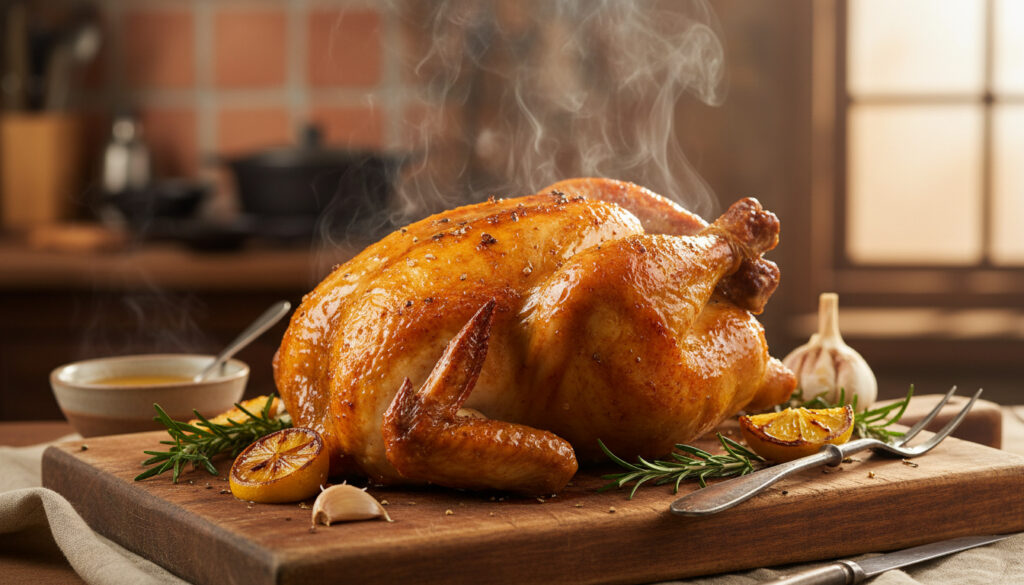
Poulet Roti au Four – Crispy Skin Roast Chicken Recipe
Poulet rôti au four represents the essential technique for French home-style roast chicken. A whole bird, typically weighing 1.2 to 2 kilograms, undergoes oven roasting at temperatures between 180°C and 240°C until the skin achieves a golden crispness while the breast meat remains juicy. The preparation relies on minimal seasoning—salt, pepper, butter or oil, and aromatic fillers like garlic, thyme, and lemon—yet demands precise attention to heat management and timing.
This method has occupied the center of French family dining for generations, appearing alike in countryside bistros and Parisian apartments. Unlike more elaborate poultry preparations requiring specialized equipment or rare ingredients, oven-roasted chicken succeeds through fundamental chemistry: rendering fat, evaporating moisture, and controlled protein denaturation.
Techniques from La Toque d’Or, Journal des Femmes Cuisine, and Julie Andrieu detail specific temperatures, timing protocols, and the scientific mechanisms behind textural excellence.
How to Make Poulet Roti au Four: Step-by-Step Recipe
Mastering this dish requires understanding the relationship between bird size, oven temperature, and resting duration.
| Prep Time | Cook Time | Servings | Difficulty |
|---|---|---|---|
| 15 minutes | 60-75 minutes | 4-6 people | Easy |
Critical Success Factors
- Dry the skin thoroughly: Moisture prevents Maillard reaction browning; pat the chicken completely dry with paper towels before seasoning.
- High-heat initiation: Starting at 220°C (425°F) evaporates surface water rapidly, initiating crisp skin formation.
- Strategic flipping: Rotating the bird during cooking ensures even fat rendering and prevents breast meat from drying.
- Basting cadence: Apply pan juices or water-based liquid every 15-20 minutes after the initial 20-minute seal.
- Thermometer verification: USDA guidelines specify 75°C (165°F) at the thickest part of the thigh for food safety.
- Mandatory resting: Allow 10-20 minutes post-roasting for muscle fibers to reabsorb juices before carving.
Size-Specific Specifications
| Chicken Weight | Oven Temperature | Total Cooking Time | Target Internal Temp |
|---|---|---|---|
| 1.2 kg (2.6 lbs) | 220°C / 425°F | 60 minutes | 75°C / 165°F |
| 1.5 kg (3.3 lbs) | 210°C / 410°F | 75 minutes | 75°C / 165°F |
| 1.8 kg (4.0 lbs) | 200°C / 390°F | 85-90 minutes | 75°C / 165°F |
| 2.0 kg (4.4 lbs) | 180°C / 355°F | 90 minutes | 75°C / 165°F |
| Convection adjustment | Reduce by 20°C / 25°F | Reduce by 10-15% | 75°C / 165°F |
| Cold start method | Ramp to 180°C / 355°F | 90 minutes (2kg bird) | 75°C / 165°F |
What Temperature and Time for Perfect Roast Chicken in the Oven?
Temperature selection directly impacts collagen breakdown, moisture retention, and surface browning. French culinary sources present two primary approaches: immediate high heat versus gradual temperature building.
The High-Heat Method
Preheat the oven to 200-220°C (390-425°F) before introducing the bird. This technique, endorsed by Journal des Femmes and Ma Patule, initiates rapid surface dehydration, creating the foundation for crispy skin. For a standard 1.5-kilogram chicken, maintain this temperature for the first 15-20 minutes, then reduce to 190°C if the skin browns too quickly.
The Cold Oven Alternative
Julie Andrieu advocates placing a 2-kilogram chicken into a cold oven, then setting the temperature to 180°C (355°F). This method allows gradual heat penetration, theoretically reducing the temperature differential between the exterior and interior. The technique requires precise timing—approximately 90 minutes total—and frequent flipping every 20 minutes to compensate for the lack of initial blasting heat.
When using a convection or fan-assisted oven, reduce the stated temperature by 20°C (25°F) and check for doneness 10-15 minutes earlier than conventional recipes suggest. The forced air circulation accelerates evaporation, promoting browning but potentially drying the meat if unchecked.
Timing Variables by Mass
Heavier birds require not only longer durations but often lower temperatures to prevent exterior burning before the interior reaches safe temperatures. A 2-kilogram chicken cooked at 180°C requires the full 90 minutes with multiple flips, while a smaller 1.2-kilogram bird achieves doneness in roughly 60 minutes at 220°C.
Ingredients for Classic Poulet Roti au Four
Authentic preparations emphasize ingredient quality over quantity. The following components appear consistently across traditional French recipes.
The Bird Specifications
Select a whole chicken weighing 1.2 to 2 kilograms (2.6 to 4.4 pounds). Smaller birds cook too quickly, risking dryness, while larger specimens require extended roasting that challenges skin texture. Remove giblets and pat the cavity dry.
Fats and Seasonings
Apply 50 grams (1.75 ounces or 3.5 tablespoons) of unsalted butter or high-quality olive oil. Work the fat under the breast skin when possible, creating an insulating layer that bastes the meat during roasting. Season aggressively with coarse salt and freshly cracked pepper—both inside the cavity and across all skin surfaces.
Aromatics and Flavoring
Fill the cavity with one to three whole heads of unpeeled garlic, fresh thyme or rosemary, bay leaves, and half a lemon or small onion. These ingredients steam during cooking, perfuming the meat while contributing to pan juices. Light variations add cherry tomatoes to the roasting pan for acidity.
While not essential for the classic preparation, some variations incorporate paprika for color or a dissolved bouillon cube in basting liquid for depth. These additions alter the fundamental flavor profile but remain acceptable within the technique’s framework.
How to Get Crispy Skin and Juicy Meat on Oven Roast Chicken
Achieving the textural dichotomy—shattering skin yielding to tender meat—requires manipulating moisture and heat transfer.
Surface Dehydration Technique
Water boils at 100°C (212°F); until surface moisture evaporates, the skin temperature cannot exceed this point, preventing browning. Pat the chicken completely dry with paper towels before applying fat. Some sources recommend leaving the seasoned bird uncovered in the refrigerator for several hours to desiccate the skin further.
Strategic Positioning and Flipping
Begin roasting breast-side down for the first 15-20 minutes to shield the delicate white meat from direct heat. Flip to thigh-down for the next interval, then finish breast-up for presentation. This rotation, documented by L’Atelier des Chefs, ensures the fat deposits in the thighs render completely while protecting the breast from overcooking.
Basting Mechanics
After the initial 20-45 minutes, introduce 200 milliliters (6.75 fluid ounces) of water or stock to the roasting pan. Baste the chicken every 15-20 minutes with these accumulated juices. This process cools the surface temporarily, slowing cooking, while adding moisture to the oven environment that prevents excessive drying.
Relying solely on visual cues like “golden brown” or “clear juices” risks undercooking or overcooking. Insert an instant-read thermometer into the thickest part of the thigh without touching bone. FDA safety standards require 74-75°C (165°F) with a three-minute rest period to eliminate pathogenic bacteria.
Resting and Serving Poulet Roti au Four
The final minutes outside the oven prove as crucial as the cooking itself. This sequence ensures optimal serving conditions. For more information on the nutritional benefits of spinach, click Rau bina lợi ích dinh dưỡng.
- Remove the chicken from refrigeration. Prepare aromatics and preheat the oven to specified temperature.
- Season the bird inside and out. Truss or tuck wings if desired. Place on a rack above vegetables or a water-filled pan.
- Initial high-heat roast. Begin flipping protocol if following advanced techniques.
- Continue roasting with periodic basting. Monitor skin color; tent with foil if browning too rapidly.
- Verify internal temperature reaches 75°C (165°F) at the thigh. Remove from oven.
- Rest the chicken under loose foil tent for 10-20 minutes to allow muscle fibers to reabsorb juices.
- Carve against the grain. Serve with pan juices and traditional accompaniments.
Traditional service includes Poulet rôti et ses pommes de terre, where potatoes roast beneath the bird, absorbing rendered fat and juices.
Which Factors Are Fixed Requirements vs. Flexible Preferences?
Distinguishing between food safety mandates and stylistic choices prevents dangerous shortcuts while allowing culinary creativity.
| Established Standards | Variable Techniques |
|---|---|
| Internal temperature must reach 75°C (165°F) at the thigh per USDA poultry guidelines | Starting temperature (cold oven vs. preheated) |
| Resting period of 10-20 minutes post-roast for juice redistribution | Frequency of flipping (ranges from 0 to 4 times) |
| Surface drying required for crispy skin formation | Choice of fat (butter vs. oil vs. duck fat) |
| Minimum cooking time of 60 minutes for 1.2kg birds to ensure safety | Specific herb combinations (thyme vs. rosemary vs. herbes de Provence) |
| Use of rack or elevated position to prevent steaming | Addition of vegetables to roasting pan |
Why Poulet Rôti Defines French Home Cuisine
The dish embodies the French culinary philosophy of elevating humble ingredients through technique rather than complexity. Historical records indicate variations of spit-roasted and oven-roasted chicken appearing in French cookery manuscripts since the medieval period, though the modern iteration solidified during the nineteenth century with the widespread adoption of enclosed cast-iron stoves.
Its persistence on Sunday lunch tables stems from the preparation’s reliability and the minimal active cooking time required. While the oven performs the work, hosts can prepare other courses. The resulting meal delivers the succulent satisfaction of long-cooked meats without the all-day commitment of braises or stews.
Regional variations persist, with some areas favoring the addition of Poulet au four version light preparations using lemon confit, while others emphasize butter-rich preparations reminiscent of classical haute cuisine techniques.
What Culinary Authorities Say About Method
Professional consensus emphasizes simplicity and observation over rigid adherence to timing charts.
“The perfect roast chicken requires only attention to dryness and heat. Patience during the resting period separates the amateur from the practiced cook.”
— Consensus from Julie Andrieu and traditional French culinary sources
“Flipping the bird ensures the thighs—needing higher heat—cook evenly with the breast. Neglecting this step risks dry white meat or undercooked dark meat.”
— Technical observation from La Toque d’Or
Serving Suggestions and Final Recommendations
Success with poulet rôti au four depends on respecting the interplay between time, temperature, and moisture. Select appropriate bird sizes for your oven capacity, verify doneness with a thermometer rather than observation alone, and allow adequate resting time. For a complete meal, consider the classic preparation of Poulet rôti et ses pommes de terre, utilizing the same roasting session to create perfectly cooked accompaniment vegetables.
Frequently Asked Questions
Can I use a convection oven for this recipe?
Yes. Reduce the temperature by 20°C (25°F) and begin checking internal temperature 10-15 minutes earlier than conventional recipes indicate. The forced air accelerates browning.
Is brining necessary for juicy results?
Brining remains optional. Traditional French recipes achieve moisture through basting, strategic flipping, and resting rather than pre-salting or wet brining methods.
How should I store leftover roast chicken?
Refrigerate leftover meat within two hours of cooking, storing at 4°C (40°F) or below. Consume within three to four days, or freeze portions for up to four months.
Can I prepare the chicken the night before?
Season the bird and refrigerate uncovered overnight to dry the skin thoroughly. Do not roast until the day of service for food safety and optimal texture.
What if I don’t own a roasting rack?
Arrange thickly sliced onions, carrots, or potatoes beneath the chicken to elevate it from the pan bottom. This prevents steaming and creates edible accompaniment.
Why flip the chicken during roasting?
Flipping distributes heat evenly between the breast and thighs, which cook at different rates. It also ensures uniform crispness across all skin surfaces.
More related posts
 Ted Turner: Cause of Death, Legacy, and Life of CNN Founder
 Cape Breton Regional Hospital – Location, Services, Wait Times, Hours
 Mike White: The White Lotus Creator and Survivor Contestant
 Jonas Brothers Christmas Movie: Watch A Very Jonas Christmas
 Hayden Christensen: Why He Stopped Acting and His Return
 Best Sushi Making Kits: SushiQuik Tops Beginner Reviews
 St. Denis Medical Episodes – Season 1 Guide and Recaps
 Fix Phone Speaker: Step-by-Step Troubleshooting Guide
