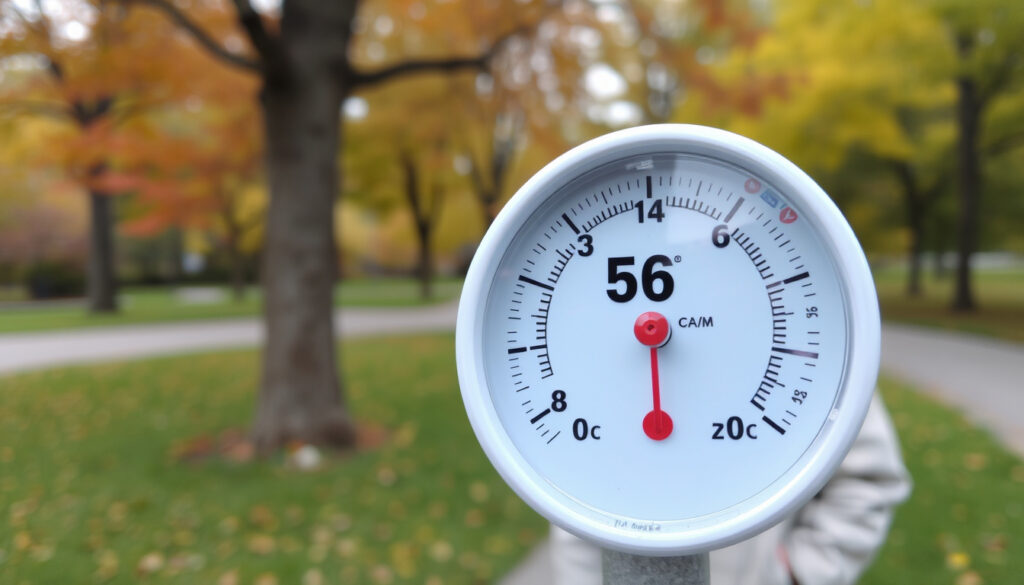
14 Celsius to Fahrenheit: Convert and What It Feels Like
The weather app says 14°C — but what does that number mean if you’re used to thinking in Fahrenheit? The value looks modest, yet whether you’re grabbing a jacket or adjusting the thermostat, the conversion triggers real decisions about clothing, comfort, and energy use. This guide walks through the exact conversion, the real-world feel of 14°C, and the practical choices it forces.
14°C in Fahrenheit: 57.2°F ·
Water freezes at: 0°C / 32°F ·
Recommended room temperature: 18–22°C (64–72°F) ·
Cold-weather jacket threshold: 10–15°C (50–59°F) ·
Thermostat setting while away: 16°C (61°F) minimum
Quick snapshot
- 14°C = 57.2°F (Inch Calculator conversion tool)
- Water freezes at 0°C / 32°F (universal constant) (Inch Calculator conversion tool)
- WHO recommends minimum indoor temp of 18°C for healthy adults (World Health Organization global health authority)
- Whether 14°C feels warm or cold depends on personal acclimatization and local climate (UK Government energy guidance)
- Optimal thermostat setting varies by insulation, home layout, and personal preference (UK Government energy guidance)
- WHO minimum indoor temp of 18°C is a safety threshold — 14°C is far below that (World Health Organization global health authority)
- A thermostat set to 14°C is typically used for frost protection, not comfort (UK Government energy advice)
- Learn the mental math trick to convert Celsius to Fahrenheit instantly
- Adjust thermostat settings to balance comfort and energy savings
- Use appropriate clothing layers when heading outdoors at 14°C
The table below organizes conversion benchmarks and temperature standards for quick reference.
| Category | Value | Source |
|---|---|---|
| 14°C in Fahrenheit | 57.2°F | Inch Calculator |
| Freezing point of water | 0°C / 32°F | Physical constant |
| Normal body temperature | 37°C / 98.6°F | Medical standard |
| Recommended room temp (WHO) | 18°C / 64°F minimum | World Health Organization |
| Comfortable outdoor range | 18–24°C / 64–75°F | NASA AFRC Weather |
| Thermostat setback (away) | 16°C / 61°F minimum | UK Government |
How do you convert C to F easily?
The formula: F = C × 9/5 + 32
The exact conversion from Celsius to Fahrenheit uses a simple formula: multiply by 9/5 and add 32. For 14°C, that works out to 14 × 1.8 = 25.2, plus 32 equals 57.2°F. This matches values listed by Inch Calculator, Farnell, and Newark. NASA’s AFRC Weather provides an official conversion chart that confirms this value.
Mental math trick: double C and add 30
If you need a quick approximation without a calculator, double the Celsius value and add 30. For 14°C: 14 × 2 = 28, plus 30 = 58°F. That’s less than 1°F off the true value — close enough for most outdoor decisions. The trick works best for temperatures between 10°C and 30°C. NFC Academy uses this technique in its teaching materials.
The quick trick trades a few degrees of precision for speed. If you need accuracy — say, for cooking or science — always use the full formula. For deciding whether to grab a jacket, the approximation works fine.
The takeaway: For anyone living in a Celsius-using country, the double-and-add-30 trick is the fastest way to talk Fahrenheit. It’s not perfect, but for weather and clothing decisions, it’s reliable enough.
Is 14 degrees Celsius hot or cold?
How does 14°C compare to typical outdoor temperatures?
- 14°C is considered cool in most climates — it’s typical of mild spring or autumn days. NASA’s conversion chart places it well below the comfortable outdoor range (18–24°C).
- At 14°C, average high temperatures in many temperate regions during April or October hover around 13–16°C. Inch Calculator notes that 14°C is generally cool rather than room-warm.
Average high/low in spring and autumn
In cities like London, New York, and Tokyo, spring (March–May) and autumn (September–November) daily highs often fall between 12°C and 18°C. So 14°C sits right in the middle of those transitional seasons. It’s neither the warmth of summer nor the bite of winter — it’s the “should I bring a jacket?” zone.
The implication: 14°C isn’t hot by any standard. It demands a light layer or a jacket, especially if the sun isn’t out or wind is present.
What does 14 degrees Celsius feel like?
Perceived temperature with wind and humidity
14°C can feel colder when wind chill or humidity comes into play. The National Weather Service (via NASA data) explains that wind increases heat loss from exposed skin, making the air feel several degrees cooler. In a light breeze, 14°C can feel like 10–12°C. Humidity also plays a role: damp air conducts heat away from the body faster than dry air, so a cloudy, damp 14°C can feel chillier than a sunny, dry one.
Comparison to common weather conditions
- 14°C is warmer than a frosty morning (0°C) but cooler than a comfortable indoor room (20°C).
- It’s similar to the temperature of a cool swimming pool or a wine cellar — definitely not “warm” by any standard.
- Many people describe 14°C as “crisp” or “bracing.” Newark notes a common wardrobe choice is a long-sleeve top with a light jacket or cardigan.
“14°C is the temperature where a simple t‑shirt feels insufficient but a heavy winter coat feels ridiculous. You need exactly the right layer — not too little, not too much.”
NASA AFRC Weather government weather research
The pattern: 14°C demands a specific layer — a long-sleeve shirt with a light jacket — because it sits at the boundary where t-shirts fail and winter coats overheat.
Is 14 degrees too cold for a house?
Minimum safe indoor temperature
The World Health Organization global health authority recommends a minimum indoor temperature of 18°C for healthy adults. For vulnerable groups — older people, children, and those with chronic illnesses — the WHO advises higher minimums. At 14°C, a home is well below that guideline. Prolonged exposure can lead to discomfort, reduced immune response, and increased risk of respiratory issues.
Health and mold risks
- Indoor temperatures below 16°C can increase blood pressure and strain the cardiovascular system.
- Cold, damp homes promote mold growth, which triggers allergies and asthma. UK Government public health guidance stresses keeping indoor spaces above 14°C to prevent condensation.
- ASHRAE professional building standards body defines thermal comfort conditions that do not treat 14°C as acceptable for occupied spaces.
14°C might be fine for a short time if you’re active (e.g., cleaning), but for sleeping, working, or relaxing, it’s too cold. A home at 14°C is a sign the heating is either turned off or set to a frost-protection mode — not a living environment.
The implication: A home at 14°C isn’t just uncomfortable — it poses health risks and can damage the building through condensation and mold. The WHO’s 18°C minimum isn’t arbitrary; it’s a safety threshold.
What’s the recommended room temperature?
Optimal temperature for sleep
Sleep researchers typically recommend a bedroom temperature of 16–19°C for optimal sleep. That range dips below the daytime comfort zone but is still above 14°C. WHO data shows that 14°C is too low even for nighttime — it can disrupt sleep and cause you to wake shivering.
Energy-saving thermostat settings
- The UK Government energy efficiency advice suggests setting the thermostat to 18–21°C for living areas, and 16°C when the house is empty.
- Setting the thermostat to 14°C when away is actually too low for most homes — it risks freezing pipes in winter and takes longer to rewarm. A setback of 16°C is the minimum recommended.
- ASHRAE Standard 55 defines acceptable thermal comfort ranges that start at 20°C for typical office settings.
Why this matters: Keeping a home at 14°C won’t save much energy because the heating system will struggle to recover quickly, and the chill may cause occupants to use space heaters — which are less efficient.
The catch: A 14°C setback may actually waste energy because the system must work harder to rewarm the space. The UK Government recommends 16°C as the lowest energy-saving target.
Five reference points, one pattern: the Fahrenheit scale climbs roughly 1.8°F per 1°C.
| Celsius (°C) | Fahrenheit (°F) | Context |
|---|---|---|
| 0 | 32 | Water freezes |
| 5 | 41 | Cold winter day |
| 10 | 50 | Cool autumn morning |
| 14 | 57.2 | Mild spring/autumn – jacket weather |
| 15 | 59 | Common in transitional seasons |
| 20 | 68 | Ideal room temperature |
| 25 | 77 | Warm summer day |
| 30 | 86 | Hot day |
| 37 | 98.6 | Body temperature |
| 100 | 212 | Water boils |
Pros and cons of keeping a home at 14°C vs 20°C
Upsides
- Lower heating bill if you can tolerate the cold
- Reduces risk of overheating and related health issues
- Good for short periods when away to save energy
- May help some people sleep if they prefer cold bedrooms
Downsides
- Below WHO minimum — can impair immune function over time
- Increases risk of mold and condensation damage
- Makes home feel uncomfortable for sitting, working, or relaxing
- Heating system takes longer to rewarm, reducing efficiency gains
The verdict: While 14°C might save on heating bills temporarily, the health risks and potential damage to your home outweigh the savings. The WHO’s 18°C minimum is the safer target.
Steps for mental conversion of Celsius to Fahrenheit
- Double the Celsius value. For 14°C: 14 × 2 = 28.
- Add 30. 28 + 30 = 58°F. That’s your rough Fahrenheit temperature.
- Optional: adjust for accuracy. If you need the exact number, use the formula: °F = °C × 1.8 + 32. For 14°C: 25.2 + 32 = 57.2°F.
- Practice with common points. Memorize 0°C = 32°F, 10°C = 50°F, 20°C = 68°F, 30°C = 86°F. Then interpolate.
For anyone living in a Celsius-using country, the double-and-add-30 trick is the fastest way to talk Fahrenheit without a calculator. It’s not perfect, but for weather and clothing decisions, it’s reliable enough.
The pattern: These four steps turn any Celsius temperature into a usable Fahrenheit number in under five seconds — no calculator required.
Confirmed Facts
- 14°C is exactly 57.2°F (Inch Calculator)
- Water freezes at 0°C (NFC Academy)
- WHO recommends a minimum indoor temperature of 18°C for healthy adults (World Health Organization)
- The double-and-add-30 trick yields a reasonable approximation
What’s Unclear
- Whether 14°C feels warm or cold depends on personal acclimatization and local climate
- Optimal thermostat setting varies by home insulation, layout, and personal preference
“The minimum indoor temperature for healthy adults is 18°C. Temperatures below that can increase the risk of respiratory and cardiovascular problems.”
World Health Organization global health authority
“Wind chill makes 14°C feel significantly colder on exposed skin. A light breeze can reduce the perceived temperature by 3–5°C.”
National Weather Service via NASA AFRC Weather government weather research
“Setting your thermostat to 16°C when you’re away is the lowest recommended setting to prevent freezing pipes while saving energy. 14°C is a frost-protection level, not a comfort level.”
UK Government energy efficiency advice
14°C sits at a crossroads: it’s too warm for frost but too cool for comfort without a jacket or a heater. For anyone in a temperate climate, the choice is clear: wear a light layer outdoors, and if your thermostat reads 14°C indoors, turn up the heat — your health and your home will thank you.
The bottom line: You need layers outdoors and heat indoors when the thermometer reads 14°C. Your health and home require more than what 14°C delivers.
For an exact mathematical breakdown and formula, you can refer to this detailed 14°C to 57.2°F conversion guide.
Frequently asked questions
What is 15 Celsius in Fahrenheit?
15°C × 1.8 + 32 = 59°F. It’s 1.8°F warmer than 14°C.
Is 14 Celsius cold for a baby?
Yes. WHO recommends 20–22°C for infant rooms. 14°C is far too cold for a baby’s sleeping environment.
What to wear in 14 degree weather?
A long-sleeve shirt with a light jacket or sweater. Jeans or trousers are fine. Add a scarf if windy.
How to convert 14 Celsius to Kelvin?
K = °C + 273.15, so 14°C = 287.15 K.
Is 14 Celsius the same as 57.2 Fahrenheit?
Yes, 14°C converts exactly to 57.2°F using the standard formula.
What temperature should I set my thermostat at night?
Sleep experts suggest 16–19°C. 14°C is too low for restful sleep.
Does 14 Celsius feel cold without a jacket?
For most people, yes. It’s cool enough that exposed skin will feel chilly after a few minutes, especially in breeze.
More related posts
 Merci de m’avoir écouté: Grammar, Meaning, and Alternative
 When Is Ramadan 2025? Dates by Country, Eid & Rules
 Zac Efron Plastic Surgery – Jaw Rumors Explained
 12 Days of Christmas: Start Dates, Gifts & Song Meaning
 Game of Thrones Season 8: Episodes, Failure Reasons & Ending
 The Rec Room Square One: Prices, Tickets, Menu & Reviews
 Fruits of the Holy Spirit – 9 Qualities from Galatians
 What Is a VPN Kill Switch – How It Works and Why You Need It
