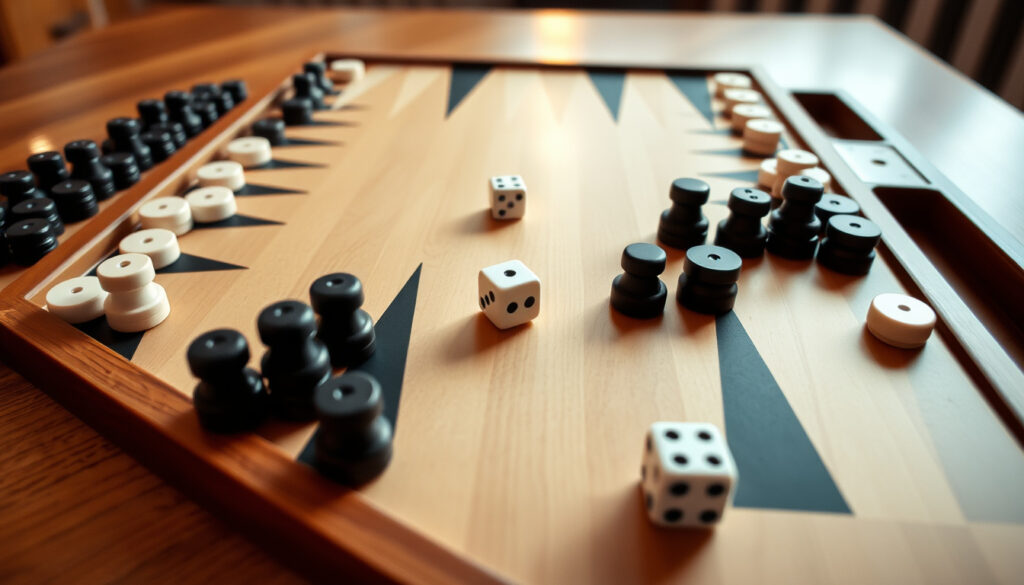
How to Play Backgammon: Rules for Beginners Guide
Imagine this: you’re at a game night, someone pulls out a board with 24 narrow triangles and 30 checkers, and suddenly everyone seems to know exactly what to do—except you. Backgammon has that effect. This guide cuts through the confusion with the exact rules the US Backgammon Federation sets out, from how the board is laid out to how your first game actually unfolds. By the end, you’ll know the setup cold, how the dice drive every move, and what it takes to win.
Players: 2 · Checkers per player: 15 · Points on board: 24 · Dice used: 2 · Objective: Bear off all checkers first
Quick snapshot
- The board has 24 points organized into four quadrants of six points each (US Backgammon Federation)
- Each player starts with 15 checkers placed in a fixed starting position (Backgammon Galore)
- Standard setup: 2 checkers on the 24-point, 5 on the 13-point, 3 on the 8-point, and 5 on the 6-point (US Backgammon Federation)
- All checkers must reach the home board (points 1–6) before bearing off begins (YouTube Beginner Tutorial)
- Whether specific regional rule variants exist outside the global standard (Backgammon Galore)
- Official publication dates for some rule sources remain undocumented in public records (Backgammon Galore)
- The doubling cube was introduced in the 1920s as a stakes mechanic (US Backgammon Federation)
- Modern backgammon rules were standardized in the 20th century (Backgammon Galore)
- Follow the step-by-step setup and first turns below to play your opening game
- Master the bearing-off sequence to close out wins once all checkers reach home
| Field | Value |
|---|---|
| Players | 2 |
| Checkers per player | 15 |
| Board points | 24 |
| Dice | 2 six-sided |
| Turns | Alternate rolls |
| Quadrants | 4 |
| Points per quadrant | 6 |
| Home board points | 6 |
What are the basic backgammon rules?
The backgammon board is divided into four quadrants of six points each, totaling 24 points across the playing surface (US Backgammon Federation). Each player commands 15 checkers in their chosen color, and the objective is straightforward: move all 15 checkers into your home board (points 1–6) and bear them off the board before your opponent does the same.
Board setup
The starting position is fixed and symmetrical for both players. Each player places exactly 2 checkers on the 24-point, 5 on the 13-point, 3 on the 8-point, and 5 on the 6-point (US Backgammon Federation). The board is divided by a central bar—your opponent’s home board (points 19–24) is where you aim your checkers, while your own home board (points 1–6) is where you ultimately bear off.
The implication: once you understand the fixed starting geometry, every decision in the game flows from how efficiently you move pieces toward those home-board targets.
The two players face each other across the board. If you’re looking at your own setup, your checkers occupy points 24, 13, 8, and 6. Your opponent’s pieces sit on the corresponding mirror points from their perspective.
Movement rules
To begin, each player rolls one die. The player showing the higher number moves first and uses the numbers from both dice (US Backgammon Federation). If both roll the same number, they reroll until a winner emerges. From that point on, players alternate rolling two dice each turn.
Checkers move forward only—from higher-numbered points toward lower-numbered ones. A die roll of 5 lets you move a checker 5 points in that direction. You can move two separate checkers (one per die) or move the same checker twice (once per die), but all intermediate points must be unblocked (YouTube Beginner Tutorial). If doubles are rolled, you move four times the pip number instead of two.
The catch: this forward-only movement means you can’t retreat to safety once a checker leaves the opening position.
You cannot land on a point occupied by two or more opponent checkers. Only open points—those with zero or one opponent checker—can be occupied or passed through.
Hitting and entering
When you land on an opponent’s blot—a single checker—you hit it, sending it to the bar. That checker must re-enter the game from the opponent’s farthest open point (point 24 from your opponent’s view) before you can move any other checkers (YouTube Beginner Tutorial). If no points are open for re-entry, you lose your entire turn.
The move forward only rule means your checkers travel around the board in a consistent direction, and dice pips dictate exactly how far each move extends. Dice must land flat on the right-hand section of the board; reroll if they don’t (US Backgammon Federation).
What this means: a single hit can disrupt an opponent’s carefully built position and force them to spend turns re-establishing checkers rather than advancing them.
What are the basic rules of backgammon for beginners?
For someone just learning, the core rules cluster around three areas: starting the game correctly, understanding the bearing-off process, and avoiding common misplays that cost beginners most often.
Starting the game
The opening roll determines first move, but the starting position does not. Players place their 15 checkers according to the standard setup regardless of who rolls first. Each player then rolls one die simultaneously, and the higher roll gains the first turn (US Backgammon Federation). Players can choose their checker colors freely—traditionally one dark and one light, but the rules specify no colors.
Bearing off process
Once all 15 of your checkers occupy points in your home board (points 1–6), you begin bearing off. To bear off, you roll the exact number needed to land on the point containing a checker—then you remove that checker from the board (YouTube Beginner Tutorial). If a point you need is empty, you may remove a checker from the next highest occupied point instead.
You must use dice rolls to full effect when bearing off. Wasting moves or failing to bear off efficiently is how close games slip away—and how opponents close out gammons (double wins).
Common mistakes
Two errors account for most beginner losses: leaving blots exposed without reason, and failing to bring all checkers into the home board before attempting to bear off. The first invites hits; the second makes bearing off impossible or severely inefficient.
The implication: backgammon’s learning curve isn’t about memorizing obscure rules—it’s about disciplined point-building and accepting that leaving a blot always carries risk you must weigh against the potential gain.
Is backgammon an easy game to play?
The basic rules can be explained in under five minutes. The setup, dice movement, and bearing off process don’t require any prior knowledge. Yet backgammon rewards strategic depth that players spend years developing.
Core mechanics simplicity
Rolling dice and moving checkers forward is mechanically simple. There are no hidden pieces, no complex card systems, and no variable win conditions. The board layout, checker positions, and movement rules are all visible to both players throughout the game (Holdson Rules PDF).
The pattern: transparency means there’s no information asymmetry—both players see everything and must decide under identical conditions.
Strategy depth
What makes backgammon deceptively complex is that every move creates trade-offs. Building a prime (a wall of made points) can trap your opponent’s checkers, but it also commits your own pieces. The doubling cube adds a stakes layer—once introduced, decisions about when to double become as important as the moves themselves (US Backgammon Federation).
Time to learn
Players who understand chess might find backgammon’s luck element jarring at first, but the game is generally easier to play socially than chess. The random dice element levels the playing field, meaning a beginner can compete meaningfully against experienced players from the first game.
The trade-off: luck means no game is ever truly decided until the final roll, so even skilled players can lose to dice that don’t cooperate. Unlike chess, backgammon never fully rewards perfect play alone.
How to play backgammon for beginners step by step?
These steps walk through a complete first game from unboxing to bearing off your final checker. Follow them in order and you’ll have played a full game by the end.
Setup and first roll
- Place the board between players with the home boards closest to each player. Confirm the bar runs through the center.
- Each player positions their 15 checkers: 2 on point 24, 5 on point 13, 3 on point 8, and 5 on point 6 (US Backgammon Federation).
- Both players roll one die simultaneously. The higher roll goes first and uses both dice numbers.
- If tied, reroll until the rolls differ.
Sample turns
- Roll two dice on your turn. Example: you roll 4 and 2.
- Move one checker 4 spaces and one checker 2 spaces, or move one checker 6 spaces total (4+2) if both intermediate points are open.
- If you land on an opponent’s blot, remove it to the bar immediately. You then must re-enter that checker from the opponent’s open points before continuing.
- Your turn ends when you pick up the dice.
Re-entering from the bar is mandatory before any other move. If your opponent has made all six points in their home board, no re-entry is possible—and you forfeit the turn entirely.
Endgame
- Once all 15 checkers occupy your home board points, begin bearing off.
- Roll the dice and remove checkers from the corresponding points. Example: rolling a 6 removes a checker from point 6.
- If you roll a number higher than any occupied point, remove a checker from the highest occupied point instead.
- The first player to bear off all 15 checkers wins (YouTube Full Guide).
The pattern: bearing off efficiently separates winning from losing. Every wasted roll that doesn’t remove a checker extends the game and gives your opponent more chances to catch up.
What is the backgammon starting position?
The backgammon starting position is standardized worldwide, meaning whether you learn in London or Tokyo, the opening setup is identical (Backgammon Galore). This consistency is what lets players from any background sit down and compete immediately.
Checker placement
Each player’s 15 checkers occupy four distinct points at the start:
- 2 checkers on point 24
- 5 checkers on point 13
- 3 checkers on point 8
- 5 checkers on point 6
This totals 15 checkers per player, verified across all authoritative sources (Backgammon Galore).
Home and outer boards
Points 1 through 6 form your home board—your bearing-off territory. Points 7 through 12 (inner board) and points 13 through 18 (outer board) are transitional zones. Your checkers start distributed between the outer board (points 24 and 13) and the inner board (points 8 and 6) (Yellow Mountain Imports). The home board contains the densest starting concentration—five checkers on the 6-point.
Opponent symmetry
Both players use the same numbered points but from opposite directions. When you look at point 24 from your perspective, your opponent sees it as their point 1. The setup mirrors across the central bar, creating balanced starting conditions (Smithsonian Backgammon Instructions).
The player throwing the higher number now moves their checkers according to the numbers showing on both dice.
— US Backgammon Federation (Official Rules Body)
The player who bears off all of their checkers first, wins the game.
— Smithsonian Store (Product Guide)
The implication: your path from the opening setup to bearing off requires moving all checkers clockwise around the board. There’s no shortcut or rearrangement—every game starts from this exact geometry.
Related reading: Game of Thrones Season 8 guide · Chaos Zero Nightmare Tier List
Frequently asked questions
How many checkers does each player have?
Each player has exactly 15 checkers in their chosen color. Both players combined use all 30 checkers at the start of every game.
What happens when you hit an opponent’s blot?
The opponent’s single checker is sent to the bar and must re-enter from the opponent’s open points before any other moves can be made. This interruption can cost the opponent several turns.
Can you move both dice numbers on one checker?
Yes, if both intermediate points along the path are unblocked. You can move one checker the combined total of both dice, or split the roll between two checkers.
What is a back game in backgammon?
A back game is a strategy where a player holds checkers in the opponent’s home board, betting on future hits to trap opponent checkers behind a prime. It requires patience and strong dice luck to succeed.
How does the doubling cube work?
The doubling cube offers a voluntary double before a roll. If doubled, the stake doubles. The receiving player can accept (and keep the cube) or decline (and lose the current stake). A beaver allows immediate redoubling when accepted, retaining the cube.
What if both players roll the same number first?
If the opening rolls are identical, both players reroll until one shows a higher number. The winner moves first, using the numbers from both dice from that deciding roll.
Are there variants for backgammon?
The rules are globally standardized for competitive play. Some casual settings add optional elements like the doubling cube or modified bear-off rules, but the core mechanics of movement, hitting, and bearing off remain consistent.
More related posts
 Isa Briones: Ethnicity, Age, Family, and Career Facts
 Medal Count 2026 Olympics: Final Standings and Key Results
 Queen Victoria: Facts, Family, Cause of Death & More
 Bruce Wayne Net Worth Compared to Elon Musk
 When Is the Next Toronto Blue Jays Game? 2026 Schedule & TV Info
 Matthew Broderick: Accident, Ireland Home & Biography
 How Old I Rihanna? 2026 Age, Birthday, Children & More
 Robot Vacuum and Mop – Best Combos Tested 2024
