Perfect Gin and Tonic Recipe: Ratio & Tips
There’s a reason the gin and tonic has survived centuries of cocktail trends: it’s simple, refreshing, and nearly impossible to mess up — if you know the basic rules. But that simplicity hides a surprising amount of debate over ratios, ingredients, and technique.
Classic ratio: 1:2 (50 ml gin to 100 ml tonic) ·
IBA official recipe: 50 ml gin, 100 ml tonic in a highball glass ·
Recommended ice: Fill glass to top with cubes ·
Typical garnish: Lime wedge or slice ·
Average calories: ~200–250 kcal
Quick snapshot
- Gin and tonic was developed in British India as a way to ingest quinine (Wikipedia (community-edited encyclopedia))
- The IBA specifies 50 ml gin to 100 ml tonic (Wikipedia (IBA standard))
- Fresh lime is the traditional garnish (Wikipedia (garnish convention))
- Whether Winston Churchill’s famous quote about G&T saving more lives than all doctors is authentic
- The exact origin of the first G&T (multiple competing claims)
- Whether the 1:2 ratio is universally preferred by all bartenders
- 1800s: British soldiers in India add tonic water (with quinine) to gin to make it palatable (Britannica (encyclopedia))
- 1857: Schweppes mass-produces Indian Tonic Water (Wikipedia (gin and tonic history))
- 2000s: Craft gin and premium tonic spark a G&T renaissance (Britannica (encyclopedia))
- Expect more tonic varieties (elderflower, Mediterranean) and hyper-local craft gins
- Low-ABV and non-alcoholic G&T options are growing
Five key facts at a glance — the numbers that define every G&T decision:
| Fact | Value |
|---|---|
| IBA Official Ratio | 50 ml gin, 100 ml tonic |
| Serving Glass | Highball (200–300 ml) |
| Calories per Serving | ~200–250 kcal |
| Alcohol by Volume | ~10–12% ABV |
| Quinine Content | ~20 mg per 200 ml tonic (typical) |
The implication: a single serving packs roughly the same quinine as a standard malaria prophylactic dose from the 1800s — which is why the ratio matters beyond mere taste.
What is the correct ratio of gin to tonic?
Most published recipes fall somewhere between a 1:1 and a 1:3 ratio of gin to tonic. The middle ground — 1:2 — is the most frequently recommended by bartenders and recipe developers alike.
What is the golden ratio for gin and tonic?
- The widely cited golden ratio is 1 part gin to 2 parts tonic. For example, 50 ml gin to 100 ml tonic matches the IBA official recipe (IBA standard per Wikipedia (community-edited encyclopedia)).
- Some bartenders argue for 1:3 if you want a lighter, lower-ABV drink (Hush and Whisper (cocktail guide)).
- A 1:1 ratio produces a spirit-forward G&T that emphasizes the gin’s botanicals (Umami Girl (food and drink site)).
The catch: the golden ratio is a starting point, not a rule. Your ideal ratio depends on the gin’s strength, the tonic’s bitterness, and your personal tolerance.
How much gin for 200ml of tonic?
- Using the 1:2 ratio, 200 ml of tonic calls for 100 ml of gin — but that produces a strong drink (around 20% ABV before dilution).
- Most recipes that list tonic in 200 ml increments recommend 50–60 ml of gin, which is closer to 1:3 to 1:4 (Simple Joy (recipe blog)).
- Check your tonic bottle: many craft tonics come in 200 ml single-serve cans, making the 1:2 ratio easy with 50 ml gin.
Why this matters: getting the ratio wrong is the most common G&T mistake — too little gin and the tonic dominates; too much and the drink becomes harsh.
What is the best recipe for gin and tonic?
A great G&T starts with superior ingredients. The gin, tonic, and garnish all play non-negotiable roles.
What are the essential ingredients?
- Gin: A high-quality London dry gin provides the botanical backbone (Barr Hill (distillery and cocktail resource)).
- Tonic water: Chilled premium tonic (like Fever-Tree or Q Mixers) preserves carbonation and adds balanced bitterness (Hush and Whisper).
- Lime: Fresh lime juice and a lime wedge are the gold standard — bottled juice doesn’t deliver the same brightness (Wikipedia garnish convention).
- Ice: Large, dense ice cubes melt slower, diluting the drink less.
The pattern: choosing the right tonic is as important as the gin itself, because the bitterness and sweetness directly affect the balance.
What type of gin is best?
- London dry gins like Tanqueray, Beefeater, or Bombay Sapphire are the classics for a reason — their juniper-forward profile stands up to tonic.
- New Western-style gins (e.g., Hendrick’s, The Botanist) lean on floral and cucumber notes, which pair well with lighter tonics.
- For a truly balanced G&T, choose a gin with at least 40% ABV; lower-proof gins can get lost in the tonic.
How to choose the right tonic water?
- Standard Indian tonic water has a pronounced quinine bitterness (around 20 mg per 200 ml).
- Mediterranean tonic uses citric acid instead of quinine for a softer profile.
- Elderflower tonic adds floral sweetness — a good match for floral or cucumber gins.
- Always use fresh tonic: once opened, carbonation fades within 24 hours.
How to make a traditional gin and tonic?
Step-by-step preparation
- Fill a highball or balloon glass with ice cubes to the top.
- Pour 50 ml (2 oz) of gin over the ice.
- Top with 100 ml (4 oz) of chilled tonic water, pouring gently to preserve carbonation.
- Stir once or twice —— no more —— with a bar spoon to combine.
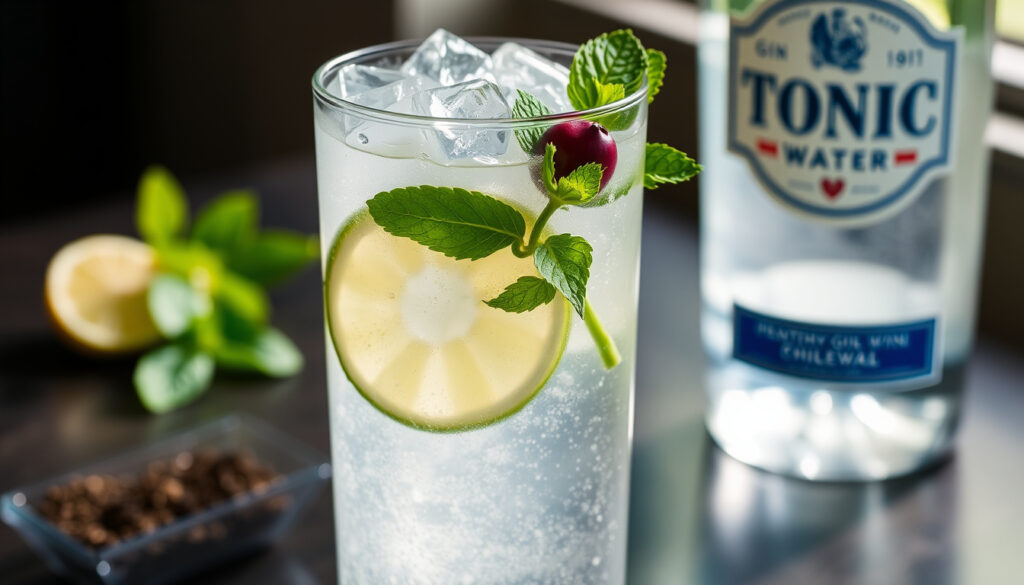
- Garnish with a fresh lime wedge or slice, squeezed gently over the drink before dropping in.
What glassware is recommended?
- A highball glass (200–300 ml) is the traditional choice, allowing room for ice and garnishes.
- A balloon or copa glass is preferred for larger-format G&Ts, especially with floral or aromatic gins, because its wide bowl concentrates the botanicals.
- Rocks or tumblers work for a short, strong G&T (1:1 ratio).
The implication: the glass shape affects aroma and dilution, so choose based on the gin’s profile.
What are common gin and tonic mistakes?
The pattern: most G&T problems trace back to four errors — wrong ratio, stale tonic, bad lime, or over-stirring.
Using the wrong ratio
- A ratio that’s too heavy on tonic drowns the gin’s botanicals; too heavy on gin makes the drink harsh.
- Stick to 1:2 as a baseline, then adjust based on the gin’s intensity and the tonic’s bitterness.
Skipping the lime garnish
- Lime isn’t just decoration —— its acidity cuts the tonic’s bitterness and lifts the gin’s citrus notes.
- No other fruit delivers the same balance; lemon is a distant second (Wikipedia alternative garnish note).
Using stale tonic water
- An opened bottle of tonic loses most of its carbonation within hours. Flat tonic makes a flat, sweet G&T.
- Use single-serve bottles or cans for the freshest bubbles.
Over-stirring
- Stirring too vigorously or too long knocks out carbonation and melts ice faster. Gentle stir once or twice is enough.
- Some bartenders skip stirring entirely and just let the gin and tonic marry as you sip.
Using low-quality gin
- Cheap gins often have harsh alcohol notes or artificial botanicals that even good tonic can’t mask.
- A mid-range London dry gin ($20–30/bottle) already delivers a significantly better G&T than the bottom shelf.
The trade-off: you can fix every mistake with better ingredients, but the biggest return on effort is the tonic water — fresh, cold, and properly matched to your gin.
What are some gin and tonic recipe variations?
How to make a gin and tonic with lemon?
- Substitute a lemon wedge for lime. Lemon adds a brighter, slightly sweeter citrus note.
- This variation works best with citrus-forward gins (e.g., Malfy con Limone) or Mediterranean tonic.
How to make a pink gin and tonic?
- Use a pink gin (infused with berries or rhubarb) or add a splash of pink grapefruit juice.
- Garnish with a slice of pink grapefruit or a few raspberries for sweetness.
How to make a Hendrick’s G&T?
- Hendrick’s gin pairs with cucumber and rose botanicals. Use a balloon glass, lots of ice, and garnish with a cucumber ribbon.
- Elderflower tonic or Fever-Tree’s Mediterranean tonic complements the floral profile.
How to make a spicy G&T?
- Add a slice of jalapeño or a pinch of black pepper to a London dry gin G&T.
- A ginger-based tonic (like Fever-Tree’s ginger ale) or a splash of ginger syrup heightens the heat.
The catch: variations are endless, but the core ratio remains the foundation.
“The gin and tonic has saved more Englishmen’s lives and livers than all the doctors in the Empire.”
Winston Churchill (attributed)
“The gin and tonic garnish is usually a slice or wedge of lime.”
Wikipedia (community-edited encyclopedia)
Whether or not Churchill actually said it, the quote captures the drink’s enduring role as a daily pleasure with a medicinal past. The quinine in tonic water was — and still is — the active ingredient that made the G&T a staple of colonial outposts.
Premium tonic costs double the supermarket brand, but the difference in carbonation and bitterness is enormous. For anyone who drinks more than one G&T a week, investing $4 in a good bottle of tonic is the single cheapest upgrade to the entire experience.
Tonic water contains enough quinine (~20 mg per 200 ml) to cause mild cinchonism at very high intake. Stick to two to three G&Ts per day maximum — and never use tonic as a substitute for malaria medication.
Clarity check: what we know and what we don’t
Confirmed facts
- Gin and tonic originated in British India as a quinine delivery system.
- The IBA standard ratio is 50 ml gin to 100 ml tonic.
- Fresh lime is the traditional garnish.
- Most recipes use a ratio between 1:1 and 1:3.
- Schweppes began mass-producing tonic water in 1857.
What’s unclear
- The authenticity of Churchill’s quoted remark about G&T saving lives.
- The exact inventor of the first gin and tonic (multiple claimants).
Frequently asked questions
What is the best gin to use for a G&T?
How long does tonic water stay fizzy after opening?
Can I use bottled lime juice instead of fresh?
How do I make a non-alcoholic gin and tonic?
What is the difference between Indian tonic and Mediterranean tonic?
Should I stir a gin and tonic?
Why does my G&T go flat so quickly?
What ice shape is best for a gin and tonic?
For any home bartender in the U.S. or U.K., the choice is clear: invest in a decent London dry gin, keep premium tonic on hand, and memorize the 1:2 ratio. The rest is just garnish. Or, as Churchill might have put it, the difference between a medicine you endure and a drink you look forward to.
More related posts
 Robot Vacuum and Mop – Best Combos Tested 2024
 Alessandra Ambrosio: Age, Kids, Net Worth & Weight Gain
 Soup Zen Hot Pot: Menu, Location, Reservations & Reviews
 Mayor of King town Sea on 4: Relea e Date, Ca t, Epi ode & New
 ETF vs Mutual Fund: Differences, Pros & Which to Choose
 Great Wolf Lodge Niagara – Waterpark Guide, Prices & Hours
 Olympic Mens Hockey Table 2026: Standings & Results
