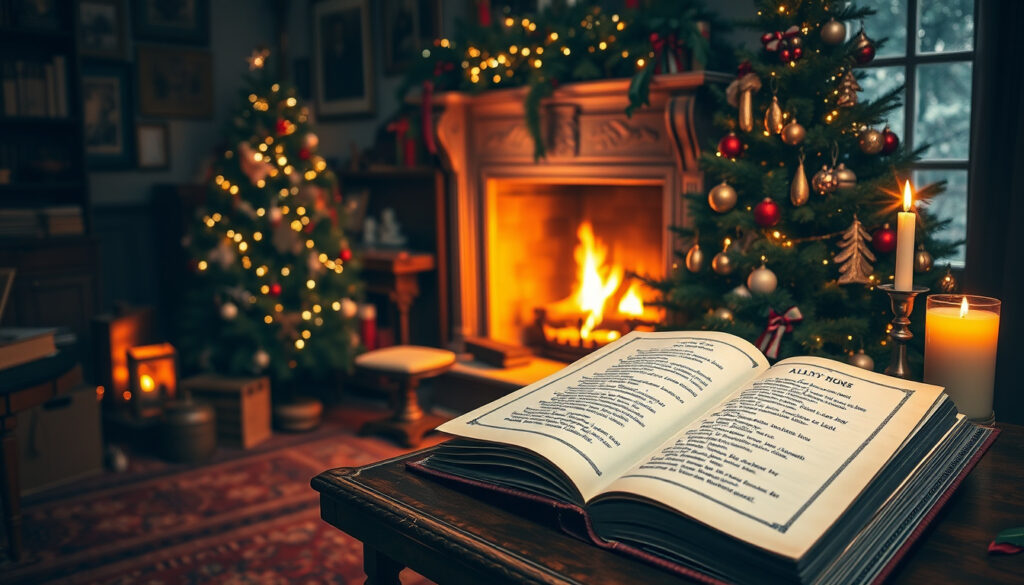
Twas the Night Before Christmas: History & Authorship
Few Christmas traditions feel as deeply embedded in the culture as settling in to read ‘Twas the Night Before Christmas on Christmas Eve. But behind those familiar lines lies a literary mystery that has divided scholars for generations—who really wrote it, and why can’t we agree?
Original publication year: 1823 ·
Number of lines: 56 ·
Rhyme scheme: AABB ·
Attributed author: Clement Clarke Moore
Quick snapshot
- Published anonymously on December 23, 1823 as “A Visit from St. Nicholas” (Encyclopaedia Britannica)
- First attributed to Clement Clarke Moore in 1837 (Columbia Magazine)
- Moore publicly acknowledged authorship in 1844 (Columbia Magazine)
- Anapestic tetrameter creates a galloping cadence (Poetry Foundation)
- Rhyme scheme: AABB couplets (Poetry Foundation)
- Twenty-eight rhyming couplets in total (Poetry Foundation)
- Originally a standalone poem, now published in many illustrated editions (Encyclopaedia Britannica)
- Often used as a read-aloud for children 4–8 (Poetry Foundation)
- Helped define the modern image of Santa Claus (Encyclopaedia Britannica)
The poem’s key facts are compiled below.
| Attribute | Detail |
|---|---|
| Original publication | December 23, 1823 in the Troy Sentinel (Encyclopaedia Britannica) |
| Author (traditional) | Clement Clarke Moore (1799–1863) (Columbia Magazine) |
| Alternative author | Henry Livingston Jr. (1748–1828) (Wikipedia) |
| First line | “’Twas the night before Christmas, when all through the house” (Poetry Foundation) |
| Rhyme scheme | AABB (Poetry Foundation) |
| Meter | Anapestic tetrameter (Poetry Foundation) |
What is the original ‘Twas the Night Before Christmas’?
Original title and publication
The poem first appeared in the Troy Sentinel on December 23, 1823, under the title “A Visit from St. Nicholas.” It was published anonymously, as was common for newspaper verse at the time (Encyclopaedia Britannica). The opening line—’Twas the night before Christmas, when all through the house—quickly became so famous that the poem is now almost universally known by that first phrase.
The 56 lines introduced a new American Santa: a jolly, plump elf flying in a sleigh pulled by eight reindeer, descending chimneys to fill stockings. As Encyclopaedia Britannica notes, this description helped cement the modern visual image of Saint Nicholas in the United States.
Clement Clarke Moore vs Henry Livingston controversy
For more than a century, Clement Clarke Moore—a professor of Greek and Hebrew literature at the General Theological Seminary—was accepted as the author. According to the traditional account, Moore first read the poem at a holiday gathering on Christmas Eve 1822; a guest, Harriet Butler, copied it down, and her friend Sarah Sackett later submitted it to the newspaper (Columbia Magazine). But in the 20th century, descendants of Henry Livingston Jr., a New York landowner and poet who died in 1828, began claiming that Livingston had written the poem years before Moore ever read it (Wikipedia).
Livingston died before Moore ever publicly claimed the work, making it impossible to produce a contemporaneous denial. Yet no manuscript in Livingston’s hand has ever surfaced—leaving the case a stack of circumstantial clues with no smoking quill.
The implication: the poem’s very success as a national treasure has made its origin story a battlefield of competing claims, with no forensic win in sight.
Who wrote ‘Twas the Night Before Christmas’?
The debate over authorship
Moore himself provided the clearest early attribution. In 1844, when asked by the Troy Sentinel whether he was the author, he replied that he had written “some lines, describing a visit from St. Nicholas, which I wrote many years ago” (Columbia Magazine). That letter has long been the cornerstone of the Moore camp.
The Livingston family’s counterargument relies on oral tradition and stylistic similarity. Livingston wrote light, humorous verse, and his supporters point to turns of phrase they consider more consistent with his voice than with the scholarly Moore’s (Wikipedia).
Evidence for Moore and Livingston
Modern computational authorship studies have tried to settle the matter. According to Wikipedia, a 2023 book reported that 16 of 17 computational tests pointed to Moore as the likelier author—though other earlier analyses (including work by scholar Donald Foster) had argued the opposite.
The table below compares the main evidence for each candidate.
| Evidence type | For Clement Clarke Moore | For Henry Livingston Jr. |
|---|---|---|
| Written admission | 1844 letter to the Troy Sentinel | No written claim from Livingston |
| Manuscript | No original manuscript in Moore’s hand (copy by Butler) | No manuscript in Livingston’s hand |
| Family tradition | Moore’s descendants accepted his authorship | Livingston descendants assert his authorship |
| Computational analysis | 16 of 17 tests favour Moore (2023 study) | Earlier Foster analysis suggested Livingston |
The pattern: without a clear manuscript, the debate rests on indirect clues and statistical probabilities, neither of which has secured a conclusive verdict.
Was ‘The Night Before Christmas’ a Plagiarism?
Plagiarism allegations
The charge that Moore plagiarized from an unpublished poem by Henry Livingston Jr. first gained steam in the mid-20th century, when Livingston’s descendants publicly campaigned for recognition (Wikipedia). The claim rests on parallels of phrasing, meter, and subject matter between Livingston’s known works and the Christmas poem. No legal ruling has ever been made, and no court has adjudicated the matter.
One Substack analysis (Tara Penry, literary historian) notes that the Troy Sentinel’s 1844 letter to Moore stated the paper had “since been informed” that Moore was the author—suggesting the attribution was reactive, not proactive.
The Livingston family case
The family’s argument gained enough traction that a mock trial was reportedly staged in Troy, New York, in 2013—though the result was a hung jury (Revisionist History podcast, Malcolm Gladwell). The debate persists because of the high emotional and cultural stakes: naming the “true” author would change how the poem is credited in anthologies and classrooms.
What this means: the plagiarism question is less a legal issue than a historical puzzle, one where the difference between the two contending authors’ public profiles may matter more than any single piece of evidence.
What is the rhyme pattern of ‘Twas the Night Before Christmas’?
Rhyme scheme and meter explained
The poem is written in anapestic tetrameter, a meter that uses two unstressed syllables followed by one stressed syllable, repeated four times per line (Poetry Foundation). This creates the famous galloping, buoyant cadence ideal for oral recitation. The rhyme scheme consists entirely of AABB couplets—the end words of the first two lines rhyme, then the next two, and so on for 28 couplets.
Example from the opening:
‘Twas the night before Christmas, when all through the house (A)
Not a creature was stirring, not even a mouse; (A)
The stockings were hung by the chimney with care, (B)
In hopes that St. Nicholas soon would be there; (B)
The pattern is consistent across all 56 lines, making the poem one of the purest examples of sustained anapestic tetrameter in English holiday verse.
How to find the rhyme pattern
- Read the poem aloud, marking the last word of each line.
- Assign the letter A to the first end-word, then B to the next distinct sound, and so on.
- If two consecutive lines share the same end-sound, they receive the same letter—that’s a couplet.
- Count the couplets: 28, not 56 lines, because each couplet covers two lines.
The trade-off: the strict AABB structure makes the poem easy to memorize but does not allow for intricate rhyme variations—the charm is in the consistency, not complexity.
Is ‘Twas the Night Before Christmas’ a book or poem?
Poem vs book format
It began as a poem—and only a poem. The original newspaper publication in 1823 was a single column of text. Only later, as its fame grew, did publishers issue illustrated editions in book form. Today dozens of picture-book versions exist, each with different artwork, but the underlying text remains the same 56-line poem (Encyclopaedia Britannica). The work is not a novel or a narrative story book; it is a long narrative poem that fits comfortably on a few pages.
Recommended age for reading
The vocabulary and rhythm are suited to children aged 4–8, especially as a read-aloud. The Poetry Foundation includes it in its children’s poetry collection. Older children and adults also enjoy the literary quality of the meter and the historical debate it sparked.
Why this matters: classifying the work correctly influences how it is taught. Treating it as a picture book oversimplifies its literary structure; treating it only as a poem underestimates its role in holiday publishing.
Timeline: key dates in the poem’s history
- 1823 — Poem published anonymously as “A Visit from St. Nicholas” in the Troy Sentinel (Encyclopaedia Britannica)
- 1837 — First attributed to Clement Clarke Moore in The New-York Book of Poetry (Columbia Magazine)
- 1844 — Moore publicly acknowledges authorship in a letter to the Troy Sentinel (Columbia Magazine)
- 1850s–present — Livingston family and later scholars dispute Moore’s claim (Wikipedia)
- 2000s — Computational linguistics studies attempt to resolve the authorship question (Wikipedia)
The sequence shows an evolving narrative: the poem’s fame grew even as its origin became more contested.
What we know for sure—and what remains unclear
Confirmed facts
- The poem first appeared in 1823 as “A Visit from St. Nicholas”; Clement Clarke Moore was the first to claim authorship publicly (Encyclopaedia Britannica, Columbia Magazine)
- The poem uses anapestic tetrameter with AABB rhyme scheme (Poetry Foundation)
- It contains 56 lines in 28 rhyming couplets (Poetry Foundation)
What’s unclear
- Whether Clement Clarke Moore or Henry Livingston Jr. actually wrote the poem (Wikipedia)
- Whether Moore knowingly plagiarized from Livingston’s unpublished work (Wikipedia)
- The exact origin of the poem before its 1823 publication (Columbia Magazine)
- Whether the poem was originally composed as a read-aloud for children or for general newspaper readers
The balance: the confirmed facts give a solid framework, but the unresolved questions keep the literary mystery alive.
Voices from the debate
“I cannot tell a falsehood … they are some lines, describing a visit from St. Nicholas, which I wrote many years ago.”
Clement Clarke Moore, in an 1844 letter to the Troy Sentinel (Columbia Magazine)
“The Livingston descendants insist that their ancestor wrote the poem, and that Moore took credit for it. But no manuscript in Livingston’s hand has ever been found.”
— Account drawn from Wikipedia
“Moore was a newly minted professor of Greek and Hebrew literature at the General Theological Seminary when he supposedly first read the poem at a holiday gathering on Christmas Eve 1822.”
Stephen Nissenbaum, professor emeritus of history, in Columbia Magazine
These voices frame the competing narratives, each adding weight to one side without ending the debate.
The verdict: why the mystery matters
The enduring power of ’Twas the Night Before Christmas lies not in who wrote it but in how it shaped a holiday. The poem gave America a Santa who drives a sleight, names eight reindeer, and slides down chimneys—images that became the backbone of Christmas iconography. The authorship debate adds a layer of literary intrigue, but it does not diminish the work’s cultural force. For literary historians, the choice is clear: either Moore or Livingston, but both men gifted the world a poem that still makes families smile each December. For casual readers, the poem itself remains the truest author.
oilandgaslawyerblog.com, tarapenry.substack.com, youtube.com
For those interested in reading the complete text alongside the authorship controversy, the full poem and its history provides a thorough examination.
Frequently asked questions
What is the meaning of ’Twas the Night Before Christmas’?
The poem depicts a family’s quiet Christmas Eve interrupted by the arrival of St. Nicholas (Santa). It celebrates the magic of anticipation and the joy of gift-giving, embedding the idea that Santa sees and rewards good behavior.
Where can I find the full text of the poem?
The complete text is available on the Poetry Foundation website and in many public domain collections such as Project Gutenberg.
Is there a movie adaptation of the poem?
While the poem itself is too short for a feature film, its characters and verses have inspired countless TV specials, animated shorts, and holiday films—including the 1974 animated feature ’Twas the Night Before Christmas.
What is the most famous line from the poem?
The opening line—“’Twas the night before Christmas, when all through the house”—is the most quoted. “Happy Christmas to all, and to all a good night!” is also widely known as the last line.
How does the poem describe Santa Claus?
Santa is described as a “right jolly old elf” with a round belly, twinkling eyes, and rosy cheeks. He enters through the chimney, carries a sack of toys, and whistles commands to his reindeer.
Why is it called ’Twas the Night Before Christmas’ instead of the original title?
The poem became so strongly associated with its first line that the line itself overtook the formal title “A Visit from St. Nicholas” in popular usage. Many reference works and libraries now list it under both names.
Can I print the poem for personal use?
Yes. The poem is in the public domain, so you can freely print, share, or include it in personal projects without copyright restrictions.
These answers cover the most common reader queries, from meaning to printing rights.
More related posts
 How to Play Backgammon: Rules for Beginners Guide
 Merci de m’avoir écouté: Grammar, Meaning, and Alternative
 General Mills Discontinued Cereals – Full List and History
 Parc de la Jacques-Cartier: Fees, Trails & Camping Guide
 Perfect Gin and Tonic Recipe: Ratio & Tips
 De De Pyaar De 2 – Cast, Release and Streaming Guide
 Canadian Home Buyers in US Down: Tariffs Driving Drop
 Golden State Warriors vs Timberwolves Timeline – 2022 Playoff Series Recap
