Playa Hermosa Costa Rica: Beaches, Safety & Activities
Few Costa Rican beaches spark as much back-and-forth among travelers as Playa Hermosa in Guanacaste. Some guides call it a calm, family-friendly bay with gentle currents, while visitor reports warn of a dangerous undertow that makes swimming risky.
Beach length: 1.2 miles (2 km) ·
Sand color: Light gray ·
Nearest airport: Daniel Oduber Quirós (LIR) – 30 minutes ·
Average temperature: 28°C (82°F)
Quick snapshot
- 1.2 miles of light gray sand (Bookaway travel guide)
- Calm waters with caution needed (Bookaway travel guide)
- Palm trees and shaded areas (Bookaway travel guide)
- Strong currents reported by travelers
- Crocodile sightings possible
- No lifeguards on duty
- Snorkeling and kayaking (Costa Rica.org tourism guide)
- Day trips to national parks (Costa Rica.org tourism guide)
- Sunset boat tours (Costa Rica.org tourism guide)
- Boutique hotels and rentals
- Mid-range pricing
- Nearby Playa Coco for more options
Five key facts at a glance, covering what matters most for planning your visit.
| Attribute | Detail |
|---|---|
| Beach length | 1.2 miles (2 km) Bookaway travel guide |
| Sand color | Light gray Bookaway travel guide |
| Swimming safety rating | Caution advised (strong currents) Sights and Sounds travel guide |
| Nearest airport | Daniel Oduber Quirós (LIR) – 30 minutes Cre Escapes travel blog |
| Best time to visit | December to April (dry season) |
What is Playa Hermosa like in Costa Rica?
Beach and scenery
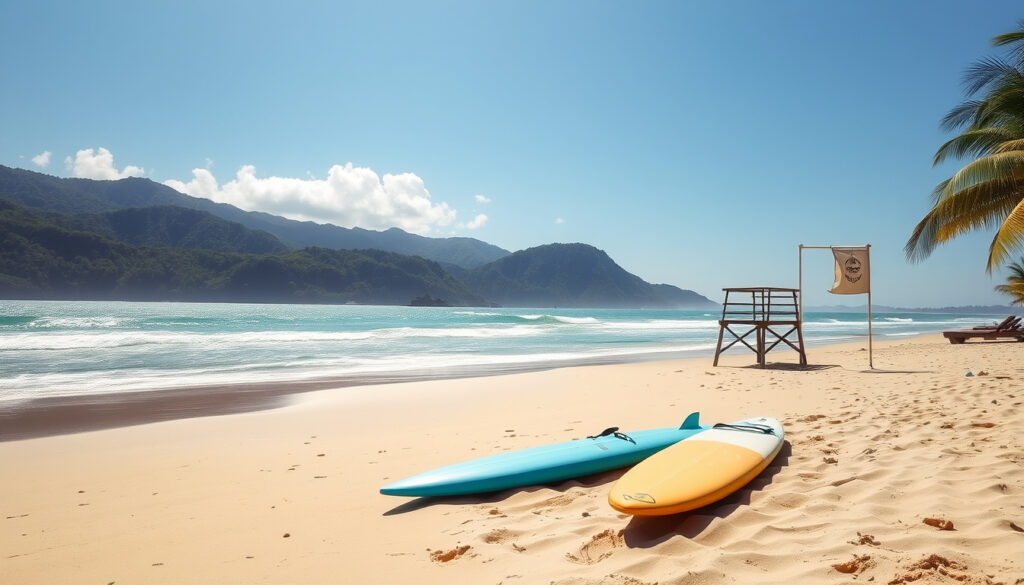
- Playa Hermosa’s defining feature is its light gray sand stretching roughly 2 kilometers along the Gulf of Papagayo coast. Bookaway travel guide describes the sand as “gray or dark gray” and the water as “clear blue.” Palm and fig trees line parts of the shore, providing natural shade.
The beach forms a sheltered bay, which is why several travel guides describe it as one of the calmer swimming beaches in Guanacaste. Cre Escapes travel blog lists it among the safer options in the region. That said, “sheltered” does not mean “risk-free”—current conditions can change with tide and season.
A sheltered bay reduces wave energy, but riptides form independently of surface conditions. Travelers should assess the water before entering rather than assuming calm equals safe.
Vibe and atmosphere
- Playa Hermosa is noticeably quieter than its neighbor Playa Coco. MyTanFeet travel blog calls it “quiet and low-key rather than nightlife-driven.” The beach draws a mix of couples, families, and solo travelers who prioritize rest over revelry.
Commercial development is modest—a handful of beachfront restaurants, a small grocery store, and no large resort chains. This low-density feel is part of the appeal for visitors who want to escape the package-tour scene.
Location and access
- Playa Hermosa sits in Guanacaste province on Costa Rica’s northern Pacific coast, about 30 minutes by car from Daniel Oduber Quirós International Airport in Liberia. Two Weeks in Costa Rica travel guide and Cre Escapes travel blog both cite the 30-minute drive. The access road is paved, making it easy to reach with a rental car or taxi.
Importantly, this Playa Hermosa is distinct from the surf-oriented Playa Hermosa in Puntarenas province. Cre Escapes travel blog makes the distinction clear: the Guanacaste version is a calm bay beach, not a surf break. Confusing the two is a common mistake when booking accommodation.
Bottom line: Playa Hermosa Guanacaste is a quiet, gray-sand beach in a sheltered bay, accessible via paved road 30 minutes from Liberia airport. It is not a surf beach—that’s the other Playa Hermosa in Puntarenas. First-time visitors should verify they are booking in the right province.
Is Playa Hermosa safe for swimming?
Swimming conditions
- Travel guide accounts of swimming safety at Playa Hermosa are contradictory. Sights and Sounds travel guide describes the beach as a “sheltered bay with calm water suitable for swimming.” Cre Escapes travel blog lists it as “one of the safer beaches in Guanacaste for swimming.”
Yet visitor reports paint a different picture. A 2025 TripAdvisor review warns: “Playa Hermosa is definitely NOT SAFE FOR SWIMMING. Even going in just above the knees can drag your butt…” The discrepancy likely depends on tide level, season, and the specific spot along the 2-km beach where you enter the water.
Riptide warnings
- Bookaway travel guide says the beach “usually lacks strong rip currents and undercurrents in the sheltered bay,” framing it as family-friendly. But the same source notes that conditions vary, and no official lifeguard presence is confirmed.
The contradiction between guidebook descriptions and first-hand warnings is significant. Local tour operators familiar with the area recommend Playa Coco or Playa Panama for swimming and suggest that Hermosa is better suited for beach walks, sunbathing, and views.
No official lifeguard service is documented at Playa Hermosa. For travelers who prioritize swim safety, the nearby alternatives (Playa Coco, Playa Panama) offer more reliable conditions with busier beaches and more eyes on the water.
Wildlife concerns (crocodiles)
- Crocodile sightings have been reported in the Playa Hermosa area, though no centralized incident log exists. The Sights and Sounds travel guide acknowledges crocodile presence as a known but infrequent concern. The lack of an official database makes it difficult to assess actual risk frequency.
What this means: crocodile encounters appear to be rare but not zero. Travelers should avoid swimming near river mouths or brackish water outlets, especially during rainy season when freshwater runoff attracts wildlife closer to shore.
Bottom line: Swimming safety at Playa Hermosa is contested between guidebooks (which call it calm) and travelers (who report dangerous undertow). There are no lifeguards and crocodile sightings are possible. Families and weak swimmers: choose Playa Coco or Playa Panama instead. Confident swimmers: enter cautiously and only at mid-tide.
What is there to do around Playa Hermosa, Costa Rica?
Water sports and snorkeling
- Snorkeling is the most frequently cited water activity at Playa Hermosa. Costa Rica.org tourism guide lists swimming and snorkeling as “the core activities.” Kayaking, stand-up paddleboarding, and banana boat rides are also available. Two Weeks in Costa Rica travel guide mentions jet ski rentals operating from the beach during high season.
The Gulf of Papagayo is known for its marine life. Two Weeks in Costa Rica travel guide describes the area as “especially strong for fishing, snorkeling, and scuba diving.” The Catalina Islands, a short boat ride away, are cited as the prime diving destination for seeing sharks, turtles, and rays. Costa Rica.org tourism guide calls the Catalinas “the best spot for scuba diving” in the region.
Day trips and nearby attractions
- Playa Hermosa’s location makes it a practical base for exploring Guanacaste. Rincon de la Vieja National Park is about a 90-minute drive and offers volcanic hot springs, hiking trails, and wildlife viewing. Boat tours from Playa Hermosa itself are marketed for snorkeling, fishing charters, and coastal exploration. Sights and Sounds travel guide and Two Weeks in Costa Rica travel guide both detail boat tours departing from the beach.
ATV tours and sunset cruises are also commonly booked from the area—operators typically pick up from hotels in Playa Hermosa and nearby Playa Coco.
Dining and nightlife
- Nightlife at Playa Hermosa is minimal. The beach has a few casual beachfront restaurants and bars, but the strip is not built for late-night activity. MyTanFeet travel blog highlights Aqua Sport as a popular beachfront spot with happy hour, live music, sunset drinks, swings, lounge seating, and a volleyball net.
For more robust nightlife, Playa Coco—a 10-minute drive—offers a wider selection of bars, clubs, and late-night restaurants. MyTanFeet travel blog positions Playas del Coco as “the better nearby option for nightlife.” The trade-off: you stay in quiet Hermosa and taxi to Coco when you want more energy.
Playa Hermosa offers calm evenings and sunset dining at the cost of nightlife variety. Travelers who want both—quiet accommodation plus nearby party options—get the best of both worlds by staying in Hermosa and taking a short taxi to Coco.
Bottom line: Playa Hermosa is a water-sports base with snorkeling, kayaking, and boat tours to the Catalina Islands. Day-trippers can reach Rincon de la Vieja National Park. Nightlife is limited to a few beachfront bars; for more, head to Playa Coco. Travelers wanting diving should book a Catalina Islands trip.
Is Playa Hermosa better than Playa Coco?
Four dimensions that matter most to travelers, compared side by side with findings from multiple guides.
| Dimension | Playa Hermosa | Playa Coco |
|---|---|---|
| Crowd level | Quiet, low-key, fewer people MyTanFeet travel blog | Lively, more tourists, busier |
| Swimming safety | Mixed reports; caution advised; no lifeguards | Generally safer; busier beach with more oversight |
| Dining and nightlife | Casual restaurants, low-key bars | Wide selection of restaurants, bars, clubs, shopping MyTanFeet travel blog |
| Accommodation pricing | Mid-range, boutique hotels dominate | Broader range including higher-end; typically more expensive |
The pattern: Playa Hermosa wins on calm and quiet; Playa Coco wins on convenience and safety infrastructure. For a traveler whose priority is swimming with confidence, Coco is the better pick. For someone seeking a peaceful beach stay with occasional trips to a livelier area, Hermosa offers better value.
The implication: “better” depends entirely on whether you prioritize relaxation (Hermosa) or reliable swimming conditions plus nightlife (Coco). There is no universal winner—only the right fit for your travel style.
Is there a town in Playa Hermosa?
Town center and facilities
- Playa Hermosa has a small town center with a handful of hotels, restaurants, and a grocery store. It does not have a large commercial district or a downtown strip. MyTanFeet travel blog confirms that services are basic—enough for daily needs but not for extensive shopping or entertainment.
What this means for travelers: you can buy groceries, eat at local sodas (small family-run restaurants), and access basic supplies. For a pharmacy, bank, or larger supermarket, you will need to drive to Playa Coco (10 minutes) or Liberia (30 minutes).
Where to stay (hotels)
- Accommodation in Playa Hermosa is dominated by boutique hotels, mid-range rentals, and small villas. Large all-inclusive resort chains are absent, which preserves the area’s quiet character. Sights and Sounds travel guide and Cre Escapes travel blog both note the absence of major resorts as a defining feature.
The exact number of hotels currently operating is unclear—listings fluctuate with season and ownership changes. Travelers booking should verify current availability through booking platforms rather than relying on guide counts.
Getting to Playa Hermosa
- Most visitors arrive via Daniel Oduber Quirós International Airport (LIR) in Liberia. The drive is about 30 minutes on paved roads. Cre Escapes travel blog and Sights and Sounds travel guide both cite the 30-minute figure. Public buses run from Liberia and Playa Coco, but service is infrequent. A rental car is recommended for travelers who want to explore beyond the beach.
Taxis from the airport to Playa Hermosa cost approximately $40–$60 USD depending on the company and season. Ride-sharing services are not widely available in Guanacaste.
Bottom line: Playa Hermosa has a small town with basic services, boutique hotels, and no large resorts. A rental car is strongly recommended. The 30-minute drive from Liberia airport on paved roads makes it easy to reach but car-free travelers will find the area limiting.
Confirmed facts vs. what remains unclear
Confirmed facts
- Playa Hermosa has light gray sand and clear water. Bookaway travel guide
- Beach length is approximately 1.2 miles (2 km). Bookaway travel guide
- There have been crocodile sightings in the area. Sights and Sounds travel guide
- Playa Hermosa is located in Guanacaste, 30 minutes from Liberia airport. Cre Escapes travel blog
- Jet ski rentals operate during high season. Sights and Sounds travel guide
- Aqua Sport offers happy hour, live music, and sunset drinks. MyTanFeet travel blog
What’s unclear
- Exact number of hotels currently operating.
- Current lifeguard presence and seasonal safety flags.
- Frequency of crocodile encounters; lack of official incident log.
- Recent comparison of water quality between Playa Hermosa and Playa Coco.
- Up-to-date public bus schedules and taxi fare consistency.
What travelers are saying
“Playa Hermosa is definitely NOT SAFE FOR SWIMMING. Even going in just above the knees can drag your butt…”
— 2025 TripAdvisor reviewer TripAdvisor user review
“We recommend Playa Coco or Playa Panama for swimming; Hermosa is better for views and relaxing.”
— Guanacaste tour operator Sights and Sounds referenced operator
The pattern in visitor feedback is consistent: the beach itself is beautiful, but swimming conditions divide opinion sharply. Travelers who stay dry or wade shallowly tend to rate the experience highly. Those who attempt full swimming often report negative experiences with currents.
The takeaway: treat swimming at Playa Hermosa as a “check conditions daily” activity, not a given. Ask your hotel desk for the day’s tide and current report before entering the water.
For travelers in Guanacaste, the choice is clear: Playa Hermosa offers a quiet, scenic beach with gray sand, good snorkeling access, and a relaxed pace—but swimming there carries real risk. The adjacent Playa Coco delivers safer swimming, more dining, and livelier nights at the cost of crowds and higher prices. Your decision comes down to one question: do you want to look at the water or trust it?
Frequently asked questions
Do I need a car in Playa Hermosa?
A rental car is recommended. While taxis and infrequent buses serve the area, having a car makes trips to Playa Coco, Liberia, and Rincon de la Vieja much easier.
Is Playa Hermosa good for families?
Mixed. The beach is quiet and scenic, but swimming safety concerns and the absence of lifeguards make it less family-friendly than alternatives like Playa Coco or Playa Panama.
What wildlife can I see at Playa Hermosa?
Marine life includes fish, rays, and turtles in the bay. Crocodile sightings have been reported, though they are infrequent. The Catalina Islands are better for seeing sharks and rays while diving.
Are there ATMs in Playa Hermosa?
No ATM is confirmed in the immediate beach area. Travelers should withdraw cash in Liberia or Playa Coco before arriving. Most hotels and restaurants accept credit cards, but smaller sodas are cash-only.
What is the nightlife like in Playa Hermosa?
Minimal. A few beachfront bars offer sunset drinks and live music on weekends. For real nightlife, visitors head to Playa Coco, 10 minutes away by taxi.
Can I surf at Playa Hermosa?
No. This Playa Hermosa is a sheltered bay with calm water, not a surf break. The surf-oriented Playa Hermosa is in Puntarenas province on the central Pacific coast.
How far is Playa Hermosa from Tamarindo?
About 1 hour 15 minutes by car (75 km). Tamarindo is on the same Pacific coast south of Playa Hermosa, making it a feasible day trip but not a short drive.
Are there crocodiles at Playa Hermosa?
Crocodile sightings have been reported in the area, though no centralized incident log exists. Travelers should avoid swimming near river mouths or brackish outlets, especially in rainy season.
More related posts
 Chinese Calendar Baby Gender 2025: Predictions & Guide
 How to Sleep Fast: 6 Science-Backed Methods
 What Is a SIM Card? How It Works, Pros and Cons
 James Love on the Spectrum: Girlfriend, Job, Age & Updates
 One Piece Live-Action Sea on 2: Ca t, Relea e Date & New
 Can Dogs Eat Blueberries – Safety, Benefits and Feeding Guide
 Perfect Gin and Tonic Recipe: Ratio & Tips
 Is Pepper Spray Legal in Canada? Rules & Alternatives
